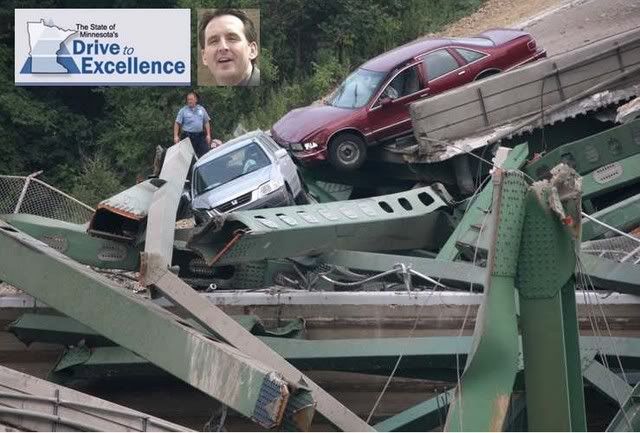
Wednesday, August 08, 2007

King Banaian and the Ford Pinto II

Spot never really read SCSU Scholars until Charlie called attention to King Banaian's rational economic analysis of the bridge collapse last week. You know what, boys and girls, it's kind of fun. The Dismal Scientist has molted at least three times since the bridge fell into the river:

  1. We cannot know what forces were at work to cause the bridge to fail. Maybe we will, God willing, eventually find the answer.
  2. The bridge fell, but it was just a consequence of the cost-benefit analysis.
  3. And then today: Perhaps it is time to consider private bridge inspectors:

Could this [problem of bridge inspection] be solved by a market for private inspections? If the government does the buying of the inspections, you would have a monopsony; would it provide the right number and quality of inspections? I don't know. I think, though, that we're deluding ourselves thinking that the current inspection system has all the right incentives and only a lack of resources.

Spot never had a professor who pulled such sleights of hand. Remarkable. Spotty has also responded to number 1 and 2. Just scroll down to find them.

The professor has not, apparently, been reading the papers; perhaps you can't get the Strib as far north as St. Cloud! Well, you can read a lot of the Strib stories on the internet, professor, and Spot recommends this one, from just today. It is the story of how inspectors called political leaders' attention repeatedly to the condition of the bridge:

For nearly a decade, report after report showed extensive problems on the bridge.

Here are the first two grafs:

State bridge inspectors warned for nearly a decade before its collapse that the Interstate 35W bridge had "severe" and "extensive" corrosion of its beams and trusses, "widespread cracking" in spans and missing or broken bolts.

Not only was the superstructure in poor condition, but certain components were "beyond tolerable limits," and one of the bridge's piers had "tilted to the north," they reported.

Perhaps Carol Molnau's reading comprehension just wasn't good enough to realize that "beyond tolerable limits" means INTOLERABLE.

I guess those dumb old state inspectors weren't completely asleep at the switch after all! And when the private sector experts came in, guess what? They said the bridge was a stinker, too:

Since the collapse, public attention has focused on consultant reports in 2006 and 2007 that expressed serious reservations about the bridge. But a Star Tribune review of older reports by state inspectors shows that their concerns had been growing since the mid-'90s.

Only from whatever hallowed hall the professor sits in could emanate the screwball notion that private inspectors would have saved the bridge. It is only politicians who could saved the bridge, and they chose not to.

Tuesday, August 07, 2007

King Banaian and the Ford Pinto

One more before turning in for the night, boys and girls. There was a little footnote in one of the professor's posts that Spot wanted to mention:

*-- more on this later as well; worth noting that such calculations can be used to determine the value of a life. See slides 12-13 of this presentation from MIT's course on regulation. I suspect this will make dogs bark.

Spot thinks the professor was saying, "Ha, ha, Spot, we economists can value a human life in economic terms, and there is nothing you can do about it!" Well, you've got Spot there, professor. You know professor, lawyers, and judges and juries calculate the value of human lives every day. It's generally after some human-caused mayhem, and it's a grisly task, professor. But you make it sound like a simple academic exercise. Perhaps to you it is.

There are a couple of things that the law considers in addition to the plain economic value of a life. One of these is pain and suffering: the anguish that a person has been put through, perhaps before their death. The little Somali girl and her mother, currently pinned under the bridge, don't you suppose they suffered before they died, perhaps for agonizing minutes or even longer as the water rose or their air supply was exhausted? The economic value of the lives of this young mother and her child were probably not great, but the loss is keenly felt by the husband and father. The law considers this, too, professor; it's called loss of society or consortium.

Spot will confess a bit of confusion about your argument, professor. He thought it was that the prospect of the bridge failure was unknowable. But then you go on to do describe a cost-benefit analysis. You can't really do a cost-benefit analysis for a bridge failure, even if you're inclined to do one, when you have no idea what the cost of the bridge failure will be, in economic terms, and certainly not in human terms as suggested above. And frankly, professor, you don't have any damned idea what the cost of this bridge failure is going to be. You don't have a clue. These are really the unknowns, not your silly-ass musings about probabilities of bridge collapse and what set a failure falls into. Outrageous.

Professor, you live in the same pitiable abstract world as the Ford executives and economists who concluded that the cost in human lives did not justify redesigning the Ford Pinto and relocating its gasoline tank so that it wouldn't explode if rear ended. Do you remember what happened to them, professor? When it learned about the admirable economic decision making of Ford, the jury assessed one of the largest punitive damage awards in American history, although it was reduced by an appeals court. Here's a little bit about the case:

Although Ford had access to a new design which would decrease the possibility of the Ford Pinto from exploding, the company chose not to implement the design, which would have cost $11 per car, even though it had done an analysis showing that the new design would result in 180 less deaths.  The company defended itself on the grounds that it used the accepted risk/benefit analysis to determine if the monetary costs of making the change were greater than the societal benefit.  Based on the numbers Ford used, the cost would have been $137 million versus the $49.5 million price tag put on the deaths, injuries, and car damages, and thus Ford felt justified not implementing the design change.  This risk/benefit analysis was created out of the development of product liability, culminating at Judge Learned Hand's BPL formula, where if the expected harm exceeded the cost to take the precaution, then the company must take the precaution, whereas if the cost was liable, then it did not have to.  However, the BPL formula focuses on a specific accident, while the risk/benefit analysis requires an examination of the costs, risks, and benefits through use of the product as a whole.  Based on this analysis, Ford legally chose not to make the design changes which would have made the Pinto safer.  However, just because it was legal doesn't necessarily mean that it was ethical.  It is difficult to understand how a price can be put on saving a human life.

There are several reasons why such a strictly economic theory should not be used.  First, it seems unethical to determine that people should be allowed to die or be seriously injured because it would cost too much to prevent it.  Second, the analysis does not take into all the consequences, such as the negative publicity that Ford received and the judgments and settlements resulting from the lawsuits. Also, some things just can't be measured in terms of dollars, and that includes human life.  However, there are arguments in favor of the risk/benefit analysis.  First, it is well developed through existing case law.  Second, it encourages companies to take precautions against creating risks that result in large accident costs. Next, it can be argued that all things must have some common measure.  Finally, it provides a bright line which companies can follow.

In the present situation, the public and the voters are going to function as the jury. Go ahead and make you summation to them on the basis of a cost-benefit analysis. Good luck, professor.

[update] When you conclude ahead of time that a certain number of deaths is acceptable, it is, to paraphrase somebody that Spot recently heard, mathematical human sacrifice. [/update]

Spotty, who is that Ralson Purina guy?

Who?

You know, that fellow you're quoting so much lately?

Oh, you must mean John Ralston Saul.

Yeah, that's the guy.

John Ralston Saul is a really smart Canuck, grasshopper. Here's his website. He's a novelist, essayist, and philosopher with a PhD in history from the University of London. Right now, Spot is working on Saul's book Voltaire's Bastards. Here's a summary of it:

Voltaire’s Bastards: The Dictatorship of
Reason in the West

1992 - Published in: Russia, Spain, Chile, Japan, Italy, France, UK, Australia, Canada, US

In a wide-ranging, provocative anatomy of modern society and its origins, John Ralston Saul explores the reason for our deepening sense of crisis and confusion. Throughout the Western world we talk end­lessly of individual freedom, yet Saul shows that there has never before been such pressure for conformity. Our business leaders describe themselves as capitalists, yet most are corporate employees and financial speculators. We are obsessed with competition, yet the single larg­est item of international trade is a subsidized market in armaments. We call our governments democracies, yet few of us participate in poli­tics. We complain about "invasive government," yet our legal, educational, financial, social, cultural and legislative systems are breaking down.

While most observers view these problems separately, Saul demonstrates that they are largely manifestations of our blind faith in the value of reason. Over the last 400 years, our "rational elites" have gradually instituted re­forms in every phase of social life. But Saul shows that they have also been responsible for most of the difficulties and violence of the same period. This paradox arises from a simple truth which our elites deny: far from being a moral force, reason is no more than an administrative method. Their denial has helped to turn the modern West into a vast, incomprehensible, direction less machine, run by process-minded experts - “Voltaire's bastards" - whose cult of scientific management is bereft of both sense and morality. Whether in politics, art, business, the military, entertainment, science, finance, academia or journalism, these experts share the same outlook and methods. The result, Saul maintains, is a civilization of immense technological power whose peoples increasingly dwell in a world of illusion.

In an even smaller nutshell, boys and girls, Saul argues that Voltaire's rational Enlightenment thinking as a way to discredit the divine right of kings has been turned into little more than an "administrative method."

Is King Banaian, with all his blather about cost-benefit ratios in the face of a major bridge collapse one of Voltaire's bastards, Spotty?

Why, yes, grasshopper, Spot thinks he is.

Boy, that Voltaire guy really go around!

Apparently so.

The plot thickens

Scene: The Patriot 1280 studio after the King and the Korb show. The King and the Korb are there, and the have Swiftee on the speaker phone.

MB: This bridge thing is really going south fast.

TS: You got that effing right!

KB: Oh, come on fellas! It's not that bad. I started a meme yesterday that the cause is in the realm of the unknowable. Gave 'em the old professorial razzle dazzle. Risk, reward, uncertainty, black swans, the whole nine yards. It should be taking hold any minute now.

TS: Pfft!

KB: Excuse me Swiftee, did you just fart at me?

TS: Uh, no.

MB: I think Swiftee is skeptical that's gonna work, King. I am, too. I've been banging the drum that the Democrat party is politicizing this practically since the moment the bridge fell. That pleases the base, but nobody else seems to be buying it. The public is looking for heads. What are we going to do?

TS: Blame the gays. I heard a rumor that Fred Phelps was going to do that.

[laughter]

TS: Well, excuse me. Just trying to help.

MB: We know, Swiftee, and we appreciate that.

KB: Well, if my brilliant initial thrust doesn't do the trick, perhaps we can blame the Democrat party.

TS: Pfft! Sorry. How are we gonna do that?

KB: We can blame light rail and the Northstar line. Money got diverted to these kooky projects and left us penniless to fix the roads and bridges.

MB: Is that true?

KB: Well, not really. Light rail has been a runaway success. It doesn't require as much operational subsidy as the naysayers thought it would. Most of the capital dollars came from Washington.

TS: But nobody rides the Northstar line!

MB: That's because it hasn't been built yet, Swiftee.

TS: Oh.

KB: It's still worth a try, though. So let's spread the word. Swiftee, you're a blog comment machine; see what you can do. Michael and I will blog about the Democrat party culpability.

TS: Culpability?

KB: Responsibility.

TS: Okay.

MB: We'll still have one weapon left in reserve.

KB: What's that?

MB: It was Bill Clinton's fault.

TS: Yea!

It's hard to soar like eagles,

when you consort with turkeys.

Composite picture by Avidor.

Fred Phelps: God DID knock the damn thing down!

Alternate title: Jesus Shrugged

You can't make this stuff up. Well, okay, Pastor Fred does, but that's not what Spot means. Several days ago now, Spot wrote a post God didn't knock the damn thing down. He was making the point that the 35W bridge failure was undoubtedly the result of human neglect. Apparently, Pastor Fred "God Hates Gays" Phelps believes that God did knock down the bridge:

Reached at the church, Shirley Phelps Roper, who is both the daughter of the pastor and one of the attorneys for the church, said that America, and Minnesota especially, have alienated God by its tolerance for homosexuality, and that the bridge collapse was an act of God’s vengeance. She said:

“The bridge stood place by the word of God and it fell by the word of God…Each of these little events is just a harbinger of the coming destruction of this American experiment. We are delivering the final call of the doomed nation.”

She said, as they have done for years, members of the church would stand “lawfully and peacefully on the public right of way” near the funerals and “put in the air words of praying and instruction and warning.”

The signs that the protesters will wave will read:

“God cast down the bridge… Thank God for 9/11… America is doomed… God hates fags… God hates fag enablers… God hates Minnesota.”

This is an admittedly slender reed upon which to lean, but Spot commends it to Governor Pepsodent and Carol Molnau. It will probably even work in a large segment of the Republican base.

Brian spanks Norm

This op-ed piece was in the Rochester Post-Bulletin yesterday. Spot isn't sure how long it will be available, so he's going to rip the whole thing off:

This week, Sen. Norm Coleman defended his support for Republican filibusters -- not only for the recent filibuster against the Levin-Reed amendment, which would have set a timeline for withdrawing American troops from the Iraqi civil war, but for the numerous Republican filibusters throughout the current Democratic-led Congress.

He also defended his recent conversion, since he once said that "I have never supported a filibuster, no matter how controversial the issue." Sen. Coleman offered various arguments based on Senate rules and, more importantly, the Constitution of the United States. Unfortunately, he twisted those rules and the Constitution in the process. Let's compare Sen. Coleman's arguments to what the Constitution and Senate rules actually say.

According to the Senate Web site, a filibuster is "any attempt to block or delay Senate action on a bill or other matter by debating it at length, by offering numerous procedural motions, or by any other delaying or obstructive actions."

The filibuster grew out of an important tradition in the United States Senate, that a senator can address the Senate on any topic, for as long as he or she wants to talk. If a senator has something to say, nobody -- not a judge, not a president, not even the other senators -- can stop him or her from saying it.

Of course, the filibuster can be abused. And it was. So the Senate adopted a rule in 1917 allowing cloture, by which a two-thirds vote can stop a filibuster and let the Senate get on with its work. The two-thirds was later lowered to three-fifths.

Which brings me to Sen. Coleman's first distortion: that the "Senate requires a bipartisan supermajority to pass legislation." Senate rules say no such thing. Many bills pass by a simple majority -- that is, the "yeas" outnumber the "nays," sometimes by a single vote -- sometimes with bipartisan support, sometimes without. The Constitution spells out exactly seven cases when a simple majority is not enough, and none involve passing legislation.

The idea that passing legislation takes a "bipartisan supermajority" is phony. If it were true, then every piece of legislation in the Senate would take 60 votes and Republicans could, and would, filibuster anything and everything that they disagree with.

Historically, the filibuster has been reserved for matters so grave that a senator was willing to shut down the Senate. The Republicans are trying to turn it into a routine device that applies to any legislation that they oppose -- basically, they are willing to shut down the Senate whenever they are outnumbered, even though they lost the last election. That's not how democracy works.

Sen. Coleman also defends his own change of heart about filibustering. Now he claims that he opposed filibustering only against judicial nominations because, he writes, "the United States Constitution specifically prohibited requiring a super majority (60 votes) on judges." The Constitution says no such thing. The constitutional rules for confirming a nomination, judicial or otherwise, are exactly the same as the rules for passing legislation. They all take a simple majority and the Constitution makes no procedural distinction among them.

Finally, Sen. Coleman argues that the Democrats are abusing cloture by filing too many cloture petitions. But the problem isn't that the Democrats are abusing cloture, since cloture is the only way of bringing filibustered legislation to an up-or-down vote where the people's elected representatives can work the people's will. Cloture isn't the problem. The problem is that Republicans are abusing the filibuster, using it to block even routine legislation, and cloture is the only remedy available.

Misrepresenting the facts is bad enough. But misrepresenting the Constitution itself is just plain wrong. After all, we could just look it up.

Brian Melendez is the chair of the Minnesota DFL Party.

Spot says the Constitution is probably hard reading for the senator. Norm undoubtedly gets his constitutional instruction from Mitch McConnell and Trent Lott.

Oh Bob!

Here's one of the Republican party faithful from out in Spot's neck of the woods, in a letter in the Strib on Tuesday:

It's time for everyone -- including gas tax proponents -- to take a step back, a deep breath and grab hold of a little logic. Regardless of whether the governor signed or vetoed the transportation bill (with the gas tax included), the money would not as yet have even started to be collected. So the reconstruction work on the I-35W bridge or any other bridge wouldn't even have been in the proposal stages, let alone under way.

That bridge, for whatever the reason, was destined to collapse. As of today, we don't know why -- 40-year-old bridges aren't supposed to just fall down. But I do know this: Even if we collect a dollar-a-gallon road tax, much of that money won't go where it is supposed to go. Just look at New Orleans and how it spent its levee money.

We've suffered a major catastrophe, and we have bonded the way communities are supposed to bond. So when I hear a politician say, "We're going to get to the bottom of this!" I cringe a little, because it really means, "We're going to pin this on somebody!"

Why not continue the bonding and healing process and leave the vendettas for another day?

BOB HUGE, EDINA

Bob is, Spot almost need not say, an idiot. Let's count some of the reasons why, boys and girls.

First, the bridge's "destiny" was not to fall. If your people had taken care of it Bob, it would still be there.

Second, money raised by gasoline taxes are required by law to go into road transportation.

Third, while Bob almost certainly likes to think that "the levee money" in New Orleans was somehow stolen by all the darkies down there, there was and perhaps still is considerable confusion about whose responsibility the levees were:

But the officials still gave conflicting opinions about who is responsible for operating, inspecting, maintaining and making emergency repairs to the levees that protect the city.

Asked directly who was responsible for emergency repairs to New Orleans levees, a U.S. Army Corps of Engineers official and a Louisiana state official both said the Orleans Levee District -- at least in the early stages of an incident.

When the former president of the levee district -- a local body -- was asked, he said the responsibility "unequivocally" falls to the Corps of Engineers.

"I look at it from the standpoint, from my level as ... they are the head. They are the brains. They have the engineering, the design, the overall [expertise]," said James P. Huey, former president of the Orleans Levee District Board of Commissioners.

The confusion also was evident in the days immediately following Katrina, but with a different tilt, testified Col. Richard P. Wagenaar, district engineer for the Army Corps of Engineers.

When corps workers attempted to reach the site to help, a local contractor turned them away, Wagenaar said.

"He literally blocked our equipment from operating on the bridge," Wagenaar said.

Committee members said the confusion over responsibility still has not been resolved.

"My mom didn't raise dumb kids, and I'm a little confused as to who has ultimate responsibility," said Republican Sen. Norm Coleman of Minnesota. [italics are Spot's]

If your boy Norm is confused, Bob, it has to be complicated, right?

Fourth, Bob, this session's veto was not the first time Governor Pepsodent vetoed a gas tax increase. He did it a couple of years ago, too, and he ridiculed a good man, Ron Erhardt, in the process. You might be interested to know Bob, although probably not, that the recently-successful ballot measure to dedicate all of the motor vehicle sales tax receipts to transportation was part of that same bill. Since it was a ballot measure, it went on the ballot for the voters over the governor's veto. The deferred maintenance on roads under Pepsodent's watch has become, well, huge.

Fifth, but certainly not last in importance, Spot has no desire to bond and heal with you and your ilk, you parsimonious scrub.

Monday, August 06, 2007

The professor bakes a sophist's pie

Perhaps it would impress a callow, wide-eyed freshman, Professor Banaian, but not a skeptical old dog. Spot is talking about the professor's rejoinder to Spot's Calculating our losses.

The professor begins by postulating three sets of bridge failures, with 3 being a subset of 2, and 2 being a subset of 1:

  1. all bridge failures,
  2. all bridge failures for which we can figure out what happened after it fell, and
  3. all bridge failures for which we could have predicted the failure ahead of time.

Spotty, this guy sounds like Donald Rumsfeld: There are known knowns, known unknowns, and unknown unknowns. Do you suppose he's obfuscating like Rummy?

We'll get into that in a moment, grasshopper. Wait—you know, you're right grasshopper—both the professor and Rumsfeld have that same eerie pedantic quality, don't they?

Then the professor says we know that the late 35W bridge was in the first set, but we don't even know if it is in set 2 yet, so how could it be in set 3?

Yeah, Spotty, how could it be in set 3?

As Spot pointed out in his linked post, without proper maintenance, every bridge is in set 3. Every one, failed and unfailed alike. In fact, if you accept the existence of a set 1—or assume it as the social "scientists" are wont to do—you've already lost the game. Here's the real world way to look at it:

  1. all bridges will fail if not maintained,
  2. it is uncertain as to how each bridge will fail, but it will fail eventually,
  3. a "vanishingly small" (to use the professor's term) proportion will fail in an unexpected way,
  4. the more heavily-traveled a bridge is, the greater the chance of its failure and the greater the consequences of that failure, and the public expects that vigilance and prudence will increase with the importance of a bridge,
  5. the proper husbandry of bridges is assumed by the public, in part because members of the public can't do it on their own, and
  6. the public will have a "vanishingly small" tolerance for screw-ups in the maintenance of bridges.

Look, boys and girls, we might find some absolutely stunning, unexpected physical explanation for the bridge failure. We could also, Spot supposes, find that it was bombarded by gamma rays from a cloaked Klingon warbird. But Spot thinks—and the public will, too—that ordinary malfeasance was afoot. The public is going to apply Louis Nizer's "rule of probability" and conclude that's what happened. Res ipsa loquiter.

Of course, the professor wants to talk about sets and uncertainty and risk, and he hopes to hell you'll buy the Klingon warbird theory. But just listen to, or better watch, Governor Pepsodent and Michael Brodkorb; they already know you won't.

But enough about the bridge

For a little while anyway. Today Spot wants to suggest some attention to an issue that is probably a little under the radar screen, for Minnesotans anyway. Some Minnesotans. It is the issue of the expansion of FISA, the Foreign Intelligence Surveillance Act. Many of you know that the president pistol whipped Congress into the passage of an expansion of FISA. But is this enough? Oh, no! Here's the president:

When Congress returns in September the Intelligence committees and leaders in both parties will need to complete work on the comprehensive reforms requested by Director McConnell, including the important issue of providing meaningful liability protection to those who are alleged to have assisted our Nation following the attacks of September 11, 2001.

Jack Balkin writes about it in Bush to Democratic Congress: Your Complete Capitulation is Not Good Enough. What the president means, of course, is "meaningful liability protection to those who are alleged to have committed war crimes following the attacks of September 11, 1991." You gotta love the president's choice of words. Orwell would have been proud.

It is also clear that some people in the CIA are clearly worried about this. In Jane Mayer's recent New Yorker article The Black Sites, there is this:

Confidentiality may be particularly stringent in this case [a Red Cross report of detainee treatment]. Congressional and other Washington sources familiar with the report said that it harshly criticized the C.I.A.’s practices. One of the sources said that the Red Cross described the agency’s detention and interrogation methods as tantamount to torture, and declared that American officials responsible for the abusive treatment could have committed serious crimes. The source said the report warned that these officials may have committed “grave breaches” of the Geneva Conventions, and may have violated the U.S. Torture Act, which Congress passed in 1994. The conclusions of the Red Cross, which is known for its credibility and caution, could have potentially devastating legal ramifications.

Concern about the legality of the C.I.A.’s program reached a previously unreported breaking point last week when Senator Ron Wyden, a Democrat on the intelligence committee, quietly put a “hold” on the confirmation of John Rizzo, who as acting general counsel was deeply involved in establishing the agency’s interrogation and detention policies. Wyden’s maneuver essentially stops the nomination from going forward. “I question if there’s been adequate legal oversight,” Wyden told me. He said that after studying a classified addendum to President Bush’s new executive order, which specifies permissible treatment of detainees, “I am not convinced that all of these techniques are either effective or legal. I don’t want to see well-intentioned C.I.A. officers breaking the law because of shaky legal guidance.”

The report also discusses how detainees were "processed":

The C.I.A.’s interrogation program is remarkable for its mechanistic aura. 'It’s one of the most sophisticated, refined programs of torture ever,' an outside expert familiar with the protocol said. 'At every stage, there was a rigid attention to detail. Procedure was adhered to almost to the letter. There was top-down quality control, and such a set routine that you get to the point where you know what each detainee is going to say, because you’ve heard it before. It was almost automated. People were utterly dehumanized. People fell apart. It was the intentional and systematic infliction of great suffering masquerading as a legal process. It is just chilling.'

Here are more of Voltaire's Bastards at work, exalting process as a way of deflecting questions about the humanity and morality of what is being done. Marty Lederman has more.

Technorati Tags: ,

Sunday, August 05, 2007

Here's an idea

In his latest column, Nick Coleman said this:

After Tim Pawlenty was elected governor in 2002, he made his running mate, Carol Molnau, commissioner of transportation. Tell me a better way to politicize transportation and control the spin on everything involving roads or bridges.

When Pawlenty vetoed the transportation bill in May, "Commissioner" Molnau was beside him, smiling. Dear, Minnesota. A transportation commissioner who grins while her department is being knifed is not a transportation commissioner.

Now, a bridge has fallen and people are dead. The buck has to stop somewhere. Molnau was in China when it happened. She probably kissed the Minnesota turf when she got back. Because a Chinese transportation commissioner whose bridge collapsed might lose her head.

We are lenient in Minnesota. Molnau can keep her head. She should lose her job.

How about if we set up a podium on one of the approaches to the collapsed bridge. Molnau can deliver her resignation while standing at the podium and addressing the wreckage, sort of a ritual political suicide.

Ooh, Spotty, that's cold.

So was the water when it closed over the people who perished.

[update] You remember Spot's discussion of King Banaian seeing black swans, don't you boys and girls? Look a little closer, professor: they're turkey buzzards circling over Pepsodent and Molnau. [/update]

Res ipsa loquitur II

Do you remember the little law lecture that Spot presented a few days ago, res ipsa loquiter? The bridge fell; it speaks for itself; there was negligence.

Here's more from a article that Spot got from a post at Across the Great Divide (link in a moment):

But one engineering expert calls the bridge collapse a systematic failure -- from inspection to the politicians.

"If a bridge of this nature falls, some major mistakes were made. And I think they were systematic," said University of St. Thomas engineering professor John Abraham. [italics are Spot's]

He said there's a lot of blame to go around.

"The welding at the joints was terrible. They had extensive rust and vertical pitting. There were vertical cracks in the cross beams," said Abraham. "This report essentially says, 'Hey, either replace the bridge or do remedial repair.' And what was done was virtually nothing."

Another good statement of the doctrine of res ipsa loquiter.

Charlie, being Charlie of course, says that the problem was one of a shortage of human capital, an "invisible crack in our infrastructure." That's right, but to Spot's ear, that sounds like an apology (as Plato would have meant that word, but in Greek of course) where condemnation is called for. Charlie goes on to say that it's a result of a generation of demeaning and dis-spiriting our public servants, which made Spot feel a little better. (Not the demeaning or the dis-spiriting, but rather Charlie's identification of them.)

But the weasels swung into action as soon as the bridge fell when Michael Brodkorb advised in a comment on Minnesota Monitor not to start pointing fingers. Jeff Fecke put his, er, finger on why.

Politics are the reason that the bridge failed, not just a simple "shortage of human capital."

Brian Lambert had an excellent post on the role of the media in getting to the bottom of this entirely preventable catastrophe:

Good journalism, as practiced collectively by reporters, photographers, editors, and executives at newspapers and TV stations, requires a full range of coverage of an event like we've experienced this week. No one can dispute the all-hands-on-deck response by every such entity in town, and there has been plenty to admire. (KSTP-TV is still getting the bulk of the critical acclaim for its work, particularly its non-stop coverage the day and night of the collapse, not that the ratings have matched their effort. But it goes to show that sometimes there is an enormous advantage in NOT having to get permission from absentee ownership in New York or DC to blow out your schedule and provide full community service ... as required by your license.)

While Reporting 101 dictates steady coverage of search operations -- the recovery of survivors, stories of good Samaritans, and official speculation on the structural issues in the collapse -- it is also entirely appropriate -- make that, "vitally necessary" -- to be peeling back the complex systemic reasons most likely behind the collapse, and to be doing it NOW, when public attention is focused on seeking explanations and solutions and emotions are high enough to demand the kind of action that might prevent another infrastructure disaster.

Unfortunately, at this moment in a situation like this, when a specific type of utterly routine political ideology appears so ripe a suspect for goring, the general media attitude is still to play back on blame-placing, as though harsh, indignant tones are "disrespectful" to the deceased or something. (To repeat, unlike Columbine or Virginia Tech, where debates on solutions spiral off into theories of psychology, sociology, etc., the solution here appears to be as basic as adequately maintaining -- or replacing -- steel and concrete.)

The standard media strategy in an assailant-free tragedy like this is to apportion roughly 50% of coverage to search and recovery logistics, 30% to feature-ish stories of valor and survival, 18% to straight stenography of political posturing, and 2% or less to what I'll call informed indignation. This situation needs more of the latter.

Which more or less gets me back to Nick Coleman. Nick, who I consider a friend, continues to draw heat from his usual adversaries as well as this tragedy's "This is No Time for Finger-Pointing" crowd, namely the various "No New Taxes!!!!" interest groups and the politicians who were cowed by them. (This same group will very soon morph into the, "Let's Move On" crowd. That is their well-practiced scenario for distracting the public enough to skitter past the role their influence played in a disaster and make a seamless return to business as usual, ASAP.)

Some pretty big heads ought to roll on this one. And some of them ought to be in the media if they cannot find it within themselves to aggressively seek the truth.

Saturday, August 04, 2007

Show Spot where, Geoff

This from an article in the Strib:

Sen. Geoff Michel, R-Edina, who had supported a five-cent-per-gallon increase, said the collapse had triggered enough concerns among Minnesotans about overall road and bridge safety that "a gas tax is near certain. We need something to catch up to the backlog.

"Minnesotans just really expect us to come up with thoughtful, bipartisan quick product. We need to deliver."

Show Spot a vote in favor of a gas tax increase, Geoff. Really. Spot will send a copy of this post to the senator by email; he invites the senator to respond.

Calculating our losses

King Banaian shakes his head wearily. Sometimes, bad things happen regardless of what we do:

As the blame game continues, I got to thinking about time to build. Roughly how long would it take to have rebuilt the bridge that fell, assuming that Governor Pawlenty had somehow been able to gaze into a crystal ball and foreseen the black swan?

I use black swan in the Taleb-ian sense. Unlike Matt's otherwise very sensible post [MNPublius], I don't think trying to figure out why the bridge fell is going to somehow improve policy. I make this point repeatedly to students -- you can sometimes do everything right and get a bad outcome due to randomness. Black swans are simply outliers -- they are things that just happen that cannot be expected within the realm of our experience. I think that until investigation concludes, you should reserve the possibility that the bridge collapse is a black swan event. (Or perhaps a gray swan, for those who've read Taleb.)

Apparently, Banaian has never built a house of cards! Banaian goes on to lecture us about marginal analysis as a method for allocating resources and making decisions:

Begin with the observation that no bridge can ever be perfectly safe. Rational allocation of scarce resources must involve marginal analysis: We allocate the money to make transportation safe up to the point where the marginal benefit of investing the dollar in project A is equal to that of project B is equal to that of project C, etc. And we invest only an amount where the increase of safety is worth the expense of providing it. I don't wait for the car 300 feet away that I judge to be traveling about 30 mph to pass before crossing the road; experience teaches that I can cross that road without incident. 99.999% of the time, it will be the case; every time I have done so before I have arrived to the other side safely. That doesn't mean the car will never hit me, just that the chance that it will is vanishingly small so that I do not allow it to disturb the decision that I'd rather be on the other side of the street now.

Banaian is right about one thing: finding the physical cause of the bridge collapse won't tell us much about public policy. That policy is made far upstream from the point where a bridge goes into the water. What the professor has given us is the unctuous, rational technocratic explanation of the bridge problem. If you accept his framing of the question, his solution seems inevitable. Shake your head in sorrow, tell the victims that your "heart goes out to them," and move on. The dollars have delivered their verdict.

Spot wants to talk about some of the elements of Banaian's framing.

Begin with the observation that no bridge can ever be made perfectly safe.

Who can argue with that? In the abstract, which is where the technocrat wants to argue, the statement is true. From this statement, Banaian wants you to conclude, boys and girls, that it is inevitable that every once in a while, the most heavily-traveled bridge in a state somewhere will just yield up its spirit and fall into the river. But that doesn't conform to what we know about bridges in general, and the 35W bridge in particular.

We know that bridges are subject to corrosion, wear and tear, and metal fatigue. From reports in media, some of which Spot and others have referred to, we also know that the 35W bridge had experienced metal fatigue and that the state—and the feds—were aware of it. Apparently, some MnDOT staffers were pretty exercised about the state of the bridge.

What we really know is that a bridge, being a mechanical device, will inevitably fail unless it is repaired or replaced. The risk of failure increases as the bridge ages. These things are just as true "no bridge can ever be made perfectly safe." Since we know bridges will fail unless cared for, and since we also know that the consequences of a failure will be, to use the governor's own term, "catastrophic," it seems sensible to be rigorous in inspection of and fixing of bridges. As Spot wrote before, God didn't knock the damn thing down.

Moreover, we know from news reports that transportation maintenance and repairs have been pushed back, sometimes by years, because of budgetary problems. It's like putting off backing up the hard drive on your computer until it's too late. You know it is going to fail sometime, yet you delude yourself into thinking that it won't be for a while yet. Then you have the "Aw s**t moment." Governor Pepsodent and his first mate Carol Molnau had their "Aw s**t moment" last Wednesday. The prudent computer operator has backups; the foolish one does not.

As the stewards of the public safety—that is what they are, after all—Pepsodent and Molnau should have focused on getting the bridge fixed—which certainly could have been done somehow—reducing the loads on it, or even closing it. But you see, boys and girls, bridge restrictions would have produced massive political pressure to raise the money to fix the bridge. And that would have been incompatible with Pepsodent and Molnau's governing philosophy and Pepsodent's desire to move out East. Now they're like the indolent computer operator caught without backups. A quarter-billion dollars or more behind the eight ball.

Roughly how long would it take to have rebuilt the bridge that fell, assuming that Governor Pawlenty had somehow been able to gaze into a crystal ball and foreseen the black swan?

We're about to find out, aren't we professor? We must always see the black swan in hard drives and bridges. The decision to play the percentages looks good until that moment it finally doesn't and one is reminded of that moment's inevitability. Banaian also errs in assuming that replacement of the bridge was the only option, intending of course to push the marginal analysis further into the realm of doing nothing.

It is of passing interest to Spot to know the physical cause of the bridge collapse: where the fatal fatigue occurred, what better anti-corrosion coatings could have been used, how the bridge may have been better designed and built. But Spot knows the proximate cause, that near cause that we can point to as the reason all those people plunged into the river: political decision making. It is a little like the man who suffers a fatal heart attack after eating bacon for every meal for twenty years. The death certificate may say myocardial infarction, but it was really the bacon.

There are some who counsel a refraining from assigning blame for the bridge collapse now. We can retrieve the whole bridge from the river, reassemble is somewhere, and conduct a careful accident analysis, but that won't do nearly as much good as identifying the public policy that is really the cause. And you really can't describe that policy without identifying its perpetrators.

Finally, Spot has a few words for you boys and girls to help you evaluate things said and written by technocrats like the professor in the future:

The social sciences, new creations of the mathematical obsession, are of course the principle example of the humanities deformed. The reduction of politics, economics, social problems and the arts to mathematical visions and obscure, hermetically sealed vocabularies may well be looked upon by those who come after us as one of the greatest follies of our civilization.

John Ralson Saul

When that case is made, boys and girls, you can be sure that Professor Banaian will be identified in the exhibits.

Friday, August 03, 2007

Consider Carol Molnau

A curious case, indeed. An anti-transit conservative ideologue, Molnau was elected as Governor Pepsodent's running mate in 2002. The governor appointed Molnau as Commissioner of the Department of Transportation (MnDOT) to serve concurrently with her job as lieutenant governor. Molnau was rejected for that post by the Minnesota Senate Transportation Committee, but a full-senate confirmation vote has never been held. Jeff Fecke muses about the desirability of holding hearings on Molnau's confirmation now, and Spot thinks it's a good idea, too.

Spot wants you to consider, boys and girls, the desirability of having someone so closely identified with the governor, and who has not been confirmed, serving as the commissioner of an important department in state government. Here are some questions raised by a commenter this morning:

Could people at MNDOT work with Molnau well? Was she able to compartmentalize her two roles? This seems impossible as Lieutenant Governor she no doubt had to support or not challenge the governor's position that Minnesota doesn't need to raise taxes in order to increase revenue for transit (even though there isn't a spare $3 billion in the general fund). It is true that the Governor selects commissioners - but given the dual responsibilities could she responsibly serve as Transportation Commissioner?

It seems that Molnau may have been at odds with staff at MnDOT over what to do with the 35W bridge:

A construction industry official who met with MnDOT about shortcomings on the I-35W bridge told the Star Tribune that there have been ongoing concerns among some MnDOT employees about the safety of this and other similar bridges.

"There were people over there that were deathly afraid that this kind of tragedy was going to be visited on us," the industry official said. "There were people in the department that were screaming to have these replaced."MnDOT has been trying to move these 'fracture critical' bridges up in their [budget] sequencing so something like this wouldn't happen," the source said.

According to the same article, concerns have existed over the 35W bridge for seventeen years:

[State bridge engineer] Dorgan said there was enough money in the agency's budget to pay for construction work on the underside of the bridge. But he and Gov. Tim Pawlenty acknowledged that transportation officials will face tough questions about the state's upkeep of the bridge, which has had known deficiencies since 1990.

This evening, Spot watched a clip from a press conference with a defensive and emotional Molnau who rejected the assertion that MnDOT might have done something to compromise the safety of the public. She said that she would never do that, and in fact, her daughter used that bridge twice a day. So maybe child endangerment should be added to the rap sheet.

Political movements often eat their own, and perhaps Molnau was emotional because she finally realized that her ideology had overcome her humanity and common sense and that she had contributed not only to a risk to the public, but to a member of her own family. That would be a sobering thing to learn about yourself.

Governor Pepsodent seeks redemption, or maybe deflection

Everything has to be re-evaluated.

Governor Pepsodent, Almanac, August 3, 2007.

He even allowed as how a gas tax might be on the table. According to Pepsodent, the Lege had rejected his transportation funding proposals; he had rejected the Lege's, and it was time to come together. Spot thinks that Pepsodent is trying to spread the blame around. You can understand why. But people aren't stupid: they recognize that it was Pepsodent and his veto-proofer Republican buddies in the legislature that have stood in the way of better transportation funding. It has been Pepsodent's way, all the way, and that means no highway. We've watched the roads crumble around us for years.

Pepsodent also said on Almanac tonight that the bridge was really a matter that had been up to the engineers at MnDOT.  And their decisions were going to be scrutinized, you betcha. But this is just another attempt to shift blame. But here's what an executive of a contractors' association had to say:

Some close observers of MnDOT continued to speculate Thursday that the decision to monitor instead of fix deficiencies in the bridge was driven by financial concerns. Dave Semerad, CEO of the Minnesota chapter of the Associated General Contractors, said everything MnDOT does is based on cost-benefit analysis.

"Let's face it. They don't have any money," Semerad said. "At the end of the day, that's the issue. This is indicative of a long-term pattern."

That is indeed the issue. We must not let Governor Pepsodent dance away from his responsibility for it.

Requiem for a Lightweight

Is it too early to begin writing the political epitaph for Governor Pepsodent? The ambitious politician, the all-hat-no-cattle cowboy, so quick to assume the prayerful attitude, but so slow to really try to inform the public about the real needs of the state and respond to those needs? The governor who prattles on about the value of the lower tax environment he created while the state trails the national average in job production? The apple polisher that John McCain—should he somehow miraculously win the lottery—would be a fool to pick as a running mate because he will remind voters around the country of the ideological bankruptcy of the Republican Party.

Spot says it is not too early. Here's an idea:

He came. He saw. He said, What the hell? It'll probably be okay.

You, boys and girls, are encouraged to offer up your ideas, too.

Res ipsa loquitur

There's time for a little law lesson before bed, boys and girls.

Aw please Spotty, it late! We're tired.

Nevertheless, grasshopper, this is important. The term res ipsa loquiter is a Latin phrase that has special meaning in the law; it means it speaks for itself. It is a legal doctrine in tort law that means that some things are so manifestly and obviously the result of negligent acts of commission or omission that a court or jury need not concern itself about how the specific negligence occurred. The consequences literally speak for themselves. Kind of like when a major interstate bridge lies in the Mississippi River. The fact that it is there bespeaks a terrible neglect.

This afternoon, Spot posted about the bridge collapse and Michael Brodkorb's efforts to divert the blame by denouncing the critics of the Pepsodent administration's malign neglect. Dave would have none of it, saying in a comment, produce a professional engineer to back you up, or shut up. Very Brodkorbian.

But commenter Andy responded to Dave, expressing the essence of res ipsa, as it is known to its friends:

No degree is necessary. Bridges don't just fall.
That is all. End of story.

Andy is correct, and no amount of squirming or screaming with change the facts. Governor Pepsodent and his happy band of bandits will have to wear this one for the rest of their lives.

Thursday, August 02, 2007

God didn't knock the damn thing down

And it wasn't terrorism. That leaves just one explanation: neglect. Ron Carey's favorite helper monkey Michael Brodkorb is all over leaving comments at Minnesota Monitor and talking on the radio about how the liberals are "politicizing" the 35W bridge collapse. Guess what Michael? Politics is the way we sort things out. Governor Pepsodent and his whole administration, poster children for government neglect, should be beaten like rented mules over this catastrophe; they will be, Spot is sure.

When you burn your butt, you have to sit on the blisters.

It is inconceivable that one of the most heavily-traveled bridges in the state could deteriorate to the literal point of collapse without some serious neglect by the people in charge of looking after it. Don't be a more painful ass than you already are by claiming otherwise, Michael. Governor Pepsodent can't even dedicate the resources necessary to properly inspect an important bridge, much less repair it.

It was obvious that Governor Pepsodent knew he was fighting a rear-guard action when he first opened his mouth at the initial presser after the collapse. In all the hustle and bustle of events, the governor managed to find the time to locate a couple of reports that said the bridge had been recently inspected! Man, they must have really gone over it with a fine-tooth comb!

In fact, there was also a federal report that stated that the bridge condition was not so spiffy. Funny how Pepsodent didn't mention that one! Spot knows what Governor Pepsodent can do with his "thoughts and prayers" for the afflicted!

But according to Michael Brodkorb, it is just so unfair to blame an administration that has stymied virtually every effort to increase transportation funding. It's not only fair, Michael, it's accurate. And now we can see just how penny wise and pound foolish the Pepsodent administration is. The economic wreckage of the bridge collapse will dwarf the cost of just replacing the bridge, on top of the horrific loss of life.

Spot finds rough justice in the fact that the Republican national convention will be in the Twin Cities next summer. Not quite as good as if it had to be held in New Orleans, but close enough. Neglected levees, neglected bridges, what's the difference?

By the way, Michael, when the conventioneers are in town next summer, why don't you rent a bus a run a "Crumbling Infrastructure" tour? Could be a real money maker.

Wednesday, August 01, 2007

Machiavellian courtiers

Former Vice President Mondale had an op-ed in the Strib today, apparently a reprint of a piece in the Washington Post. Here's the lede:

The Washington Post's recent series on Dick Cheney's vice presidency certainly got my attention. Having held that office myself over a quarter-century ago, I have more than a passing interest in its evolution from the backwater of American politics to the second most powerful position in our government. Almost all of that evolution, under presidents and vice presidents of both parties, has been positive -- until now. Under George W. Bush and Dick Cheney, it has gone seriously off track.

No kidding, Fritz.

But Spot thinks it is not so much a subversion of the office of vice president as a continuation of the role of the Machiavellian courtier in Republican administrations stretching back to Richard Nixon. Cheney has been in a position to observe and learn from the two best: Henry Kissinger and James Baker. Working behind the scenes, in secrecy, controlling access to information, marginalizing the regular organs of government, and ultimately limiting policy options available to the government: these are the hallmarks of such courtiers. The probability of such a courtier increases when you have a weak president like the Dauphin.

Spot doubts that he has to say much to introduce either Kissinger or Baker.

Kissinger in the position of National Security Adviser—not Secretary of State—negotiated the "peace accord" with North Vietnam:

Kissinger's involvement in Vietnam started prior to his appointment as National Security Adviser to Nixon. While still [a faculty member] at Harvard he had worked as a consultant on foreign policy to both the White House and State Department and, in the summer of 1967, had acted as one of a series of intermediaries between Washington and Hanoi in a peace initiative codenamed "Pennsylvania". In the autumn of 1968, he used his contacts with the Johnson administration to tip-off the Nixon camp about an anticipated breakthrough in the Paris talks, which Nixon feared could cost him the campaign.

Kissinger is updated on the latest situation in South Vietnam on April 29, 1975.

Kissinger is updated on the latest situation in South Vietnam on April 29, 1975. (Wikipedia)

Nixon had been elected in 1968 on the promise of achieving "peace with honor" and ending the Vietnam War. In office, and assisted by Kissinger, Nixon implemented a policy of Vietnamization that aimed to gradually withdraw U.S. troops while expanding the combat role of the Army of the Republic of Vietnam (ARVN) so that it would be capable of independently defending South Vietnam against the National Front for the Liberation of South Vietnam and North Vietnamese army (Vietnam People's Army or PAVN). Kissinger played a key role in a secret American bombing campaign of Cambodia to target PAVN and Viet Cong units launching raids against South Vietnam from within Cambodia's borders and resupplying their forces by using the Ho Chi Minh trail and other routes, as well as the 1970 Cambodian Incursion and subsequent widespread bombing of Cambodia. The bombing campaign inadvertently contributed to the chaos of the Cambodian Civil War, which saw the forces of dictator Lon Nol unable to defeat the growing Khmer Rouge insurgency that would emerge victorious in 1975.

And Henry loved power, a characteristic of the Machiavellian courtier:

At the height of his popularity, he was even regarded as something of a sex symbol, earning him the nickname 'Henry the Kiss'. He was seen dating such starlets as Jill St. John, Marlo Thomas, Shirley MacLaine, and Candice Bergen. He was quoted as saying "Power is the ultimate aphrodisiac". There was even discussion of ending the requirement that a U.S. president be born in America by amending the U.S. Constitution so that Kissinger could have a chance to run.

According to John Ralston Saul (in Voltaire's Bastards):

Kissinger added to his organizational skills an advanced sense of how to place himself on the trajectory of information in order to become its messenger or reinterpreter or simply in order to be able to stop it. His need to control the flow of information was tied to an obsession with secrecy and, of course, to a climate of fear which seeped into everyone's life as he ceaselessly manipulated everything within reach.

James A. Baker wasn't called the Velvet Hammer for nothing. Baker was the principal courtier of Bush the Elder; here's a quote from Baker:

The trick is getting them where you want them, on your terms. Then you have the options. Pull the trigger or don't. It doesn't matter once you've got them where you want them. The important thing is knowing that it's in your hands, that you can do whatever you determine is in your interest to do.

(Time Magazine, February 13, 1989) By the way, Baker was describing how to kill a wild turkey.

Back to what Fritz says about Cheney:

[The role of vice president] all changed in 2001, and especially after Sept. 11, when Cheney set out to create a largely independent power center in the office of the vice president. His was an unprecedented attempt not only to shape administration policy but, alarmingly, to limit the policy options sent to the president. It is essential that a president know all the relevant facts and viable options before making decisions, yet Cheney has discarded the "honest broker" role he played as President Gerald Ford's chief of staff.

The role of Dick Cheney was foreshadowed when he chose himself to run for vice president. Cheney is a consummate government manipulator, like Kissinger and Baker. He, along with Donald Rumsfeld, created an alternative intelligence network designed to create a case for war against Iraq, subverting the traditional intelligence agencies of the government, and in some cases suppressing their dissent.

Cheney's power play was facilitated by the trend of concentration of government power within the West Wing, and the marginalization of cabinet members and their staffs. Cabinet meetings are reduced to kabuki theater. Secrecy in the executive branch facilitates and encourages the rise of the courtier. It is not an accident that Nixon, Reagan, and the Bushes have had the most secret administrations in memory, maybe history.