Tuesday, October 09, 2007

An update from Janet!

Janet has updated the scolding post about layabout children that Spot mentioned here:

On Monday, The St. Paul Pioneer Press carried an article on the necessity of children doing chores around the home, not for money but responsibility and carrying their share of the load. The article includes suggestions and tips. It appears one of the major excuses for not requiring kids to do chores is that parents want to spend time with their kids without "nagging" them. We're not helping our kids be relieving them of all responsibility related to living spaces.

A major chore is picking up toys, games, etc. and no one wants to do it - maybe because there are so many of them. A simple solution here is to gather all the toys, games, etc. and give away at least 50% of them. Problem partially solved.

All right, buster! Pick up those toys or Teddy here buys the farm!

You didn't make you bed again! It goes on the auction block in the front yard right after school. And no, you may not bid on it. You have to watch, though.

Where's your hamster? I fed him to the cat. Changing the litter in the cage is a Saturday morning job, and you didn't get around to it until nearly one o'clock.

Sigh. Spot hopes that the scholarly Janet is not in the psychology department. Or a parent, for that matter.

Rape and pillage II

Alternate title: Barbarians at the Gate

In the original Rape and pillage post, Spot wrote a little about one block in Edina's efforts to keep the barbarians—speculative builders of neighborhood soul-killing monster houses—out. That post included a short video that the residents of the block recorded for presentation to the Edina City Council. Here is the video again:

After initial signals from the communications people at the city that the video could be presented, the council decided at the meeting not to show it. Here's the council deliberation:

Sorry; really sorry.

Nearly as interesting to Spot, however, was a discussion that took place later in the meeting. During a presentation by the "Massing Task Force," a truly Orwellian moniker for a group whose spokesman didn't seem to think that massing was really so bad, there was some discussion among the council members of just "letting the market solve the problem."

Spot is sad to have to inform the council that "the market" isn't going to solve the problem, unless you consider wholesale destruction of neighborhoods as a solution. It is sort of like putting foxes in the henhouse as a "market-based solution." It is a notion so naïve that it scarcely warrants discussion, but the idea that the market place is a benevolent force that will always work for the public good has gotten traction in some circles.

Well, it doesn't. The market place is a good at allocating private goods, but not at promoting or preserving public ones. The private interest, the spec builder who comes in, buys a lot and "scrapes" it to build a house that rips a hole in the neighborhood, must be compared the the public interest, the immediate neighbors interest in light and air, and the neighborhood's interest in preserving the aesthetic character of the neighborhood. The market place will never vindicate the public interest here. Never.

That's why we have zoning laws. Zoning laws exist to vindicate the public interest. And the people on that block in Edina selected council members and a mayor to enact ordinances appropriate to their protection. These are the people, many of whom have been around a long time, who vote, pay taxes, and raise families in the community, not the fly in and fly out builder.

Here's what the city has done so far:

•Edina, Minn., a Minneapolis suburb filled with rambler-style homes from the 1940s and '50s, changed its zoning in June after a spate of teardowns in the past three years. The city requires larger setbacks on narrow lots to limit the size of new homes, says Cary Teague, planning director.

"We were seeing a lot of builders tearing homes down and bringing in fill to build up the house for a walkout basement," he says. "Now, it can't be raised more than 1 foot from the existing foundation."

Homes as small as 1,200 square feet are being replaced with homes of up to 6,000 square feet. One just sold for $1.8 million, Teague says [with evident pride, says Spot].

Teague, a past president of the National Procrastinators Club (okay, Spot made that up), points with pride to the fact that setback on sidelots have been increased. Apparently so much that only a 5,500 square foot house can be built next door to Sandy Carlson! This is progress!

From the same USA Today article, here is what Atlanta is doing:

The Atlanta City Council approved a zoning ordinance last week that bans the construction of giant homes on small lots. In a compromise to appease builders, real estate agents, residents and planners, the city links the size of a home to the size of the lot. That allows big homes on big lots and small homes on small lots.

This is known, boys and girls, as a FAR, or floor area ratio limitation. Minneapolis has one now. But the big thinkers in Edina have apparently considered but rejected the idea. A FAR is the foundation of any meaningful anti-McMansion initiative. Apparently, the City of Edina isn't really serious about the problem.

Monday, October 08, 2007

Checking out the Borg

On the internets, boys and girls, there are just a few political or public policy sites, especially the blogs, that don't just rely on the printed word or the occasional tip.

That's what you do, mostly, isn't it Spotty?

Well, yes, grasshopper, but this post is not about Spot. Now, go sit in the corner, you impertinent little pup. Where were we? Oh, yes.

There are sites that do original and investigative research. One of Spot's favorites has long been Media Transparency, from our fair city, that does great work on conservative philanthropy and its effect on the media, education, and even liberal religious institutions. There are several good contributors to Media Transparency; Bill Berkowitz, who some of you may know from other venues, is an especial standout.

One of the writers, Rob Levine, who lists himself last on the roster, is actually the motive force behind Media Transparency and its sibling site, Cursor.org; the latter being a news aggregator that has been around about as long as anyone in the aggregator biz.

Is this going anywhere, Spotty?

Yes, grasshopper, it is. Rob Levine has a blog that he calls The Triumph of Conservative Philanthropy. Rob has a new post up about the integration of conservative philanthropy and the media right here in River City. Rob is a pretty good dot connecter himself:

As I have argued in numerous venues, the CAE is a "think tank" in name only; it is really an extension of the Republican party, and a cog in the larger conservative movement. The fact that a good friend of theirs is the political editor at the Trib, and one of its founders is a news columnist are indicators of a strong influence on the definition of news in the Twin Cities. Kersten herself often works in tandem with Powerlineblog; frequently you'll see a particular topic covered by Johnson or Hinderaker, only to have the story appear in Kersten's column shortly thereafter. It works the other way, too. In another post just above the one referenced in this post Johnson links to three recent Kersten columns warning of the anarchy awaiting the country for tolerating Critical Mass bike rides.

Power Line wrote about the bicyclists, too? Boy, Scott Johnson is One of Three and Katie is Zero of One from the Borg, aren't they Spotty?

You watch too much television grasshopper.

Sunday, October 07, 2007

Cyclophobia!

Katie may be more afraid of bicyclists than Muslims. Hard to believe, boys and girls, especially since the majority of bicyclists, at least in the Twin Cities, aren't brown. Katie's latest column is the second one on in a row about the pitiless abuse of minivans and SUVs and their suburban occupants by a mob—a mob, Katie swears—of bicyclists!

Critical Mass, the loosely organized bicycle group that ties up rush-hour traffic once a month in Minneapolis, has demonstrated who rules our streets. But Minneapolis isn't the only place where the Mass mob has strong-armed the police and City Hall, and left outraged motorists fuming but impotent.

Today, Critical Mass cyclists cow commuters in more than 300 cities, from Denver to Rio de Janeiro, according to the San Francisco Chronicle.

The ride got its start in San Francisco (where else?) in 1992 with about 50 cyclists. Authorities there looked the other way as riders ran red lights and snarled traffic. Soon, the event was drawing hundreds, even thousands, of riders.

And therein lies a cautionary tale for Minneapolis.

We know, of course, that anything that started in San Francisco can't possibly be good.

Katie has dropped a couple of broad hints about what she thinks that the Minneapolis police should do:

Today, ugly confrontations are a fact of life in the City by the Bay, and traffic is a bad trip on the last Friday of the month. Cyclists sometimes scratch or beat on cars, taunt or spit at motorists, and come close to running down pedestrians.

[ . . . ]

How did San Francisco get into this state of anarchy?

The city ran up the white flag 10 years ago, after a pitched battle in July 1997 set a pattern of capitulation.

Katie, of course, is made of sterner stuff. She would not hesitate to crack some heads in the name of a quicker commute! Spot thinks that Katie's real problem is that she is afraid that the local constabulary isn't going to be sufficiently tyrannical during the Republican National Convention next summer, perhaps inconveniencing some of her buds.

Meanwhile, Avidor sent Spot a great parody of Katie's last column on the bicycling mobsters.

Tom Maertens is angry

At the Democrats. And who could blame him? Please read A Party of Eunuchs.

Technorati Tags: ,

Please sir, can I have some more?

Spot is a latecomer to SCSU Scholars, especially the offerings of the Iron Maiden, Janet. It's been Spot's loss. Today, Janet lamented about this:

Spoiled Kids

On a recent bike ride through our neighborhood I saw examples like the following. Mom works outside the home, as does Dad. They have two boys, about ages 10 and 12. Guess who does the yard work?

Dad mows the grass; mom sweeps if off the road and walkways. Apparently the kids were told to walk the dog so they got on their bikes, put the dog on a leash and "walked" it for maybe five minutes. Both kids returned home and are now in the house. Meanwhile, Mom and Dad are finishing the lawn activities.

Want to guess when these two boys will become responsible?

Janet's right. By the time kids are ten, they really should be yoked to a plow. If they aren't put in the harness by then, they might not grow up to be the same joyless plodder you are, Janet. That would be tragic.

Spot has a piece of advice for you Janet: mind your own damn business. You are the kind of person that helped define the term "common scold."

Friday, October 05, 2007

We've grown accustomed

From an excellent post at Inside Minnesota Politics about Michael Brodkorb's tactics:

We've grown accustomed to the lies and distortions coming out of Brodkorb's media enticing rumor mill. Thank goodness the media has learned its lessons and doesn't take what he says as gospel. Star Tribune reporter Mark Brunswick was smart enough to check out this latest distortion with Sarvi's campaign first and left Brodkorb's smear out of his printed story. Brunswick knows what a lot of other media folks now know, Brodkorb's intent is to misinform for political gain.

It made Spotty think of this: 

The right wing, on maneuvers

Recognize any of these guys?

 
Rifle Rebound - The best free videos are right here

And in 2007, the chances are even better!

John Kenneth Galbraith wrote this many years ago:

A speculative outbreak has a greater or less immunizing effect. The ensuing collapse automatically destroys the very mood speculation requires. It follows that an outbreak of speculation provides a reasonable assurance that another outbreak will not immediately occur. With time and the dimming of memory, the immunity wears off. A recurrence becomes possible. Nothing would have induced Americans to launch a speculative adventure in the stock market in 1935. By 1955 the chances are very much better.

As Spot writes this, the DOW is at about 14,100, up over 100 points for the day. Spot wonders what part of "speculative bubble" that the public doesn't understand. One might think that the recent experience of the real estate market would be a cautionary tale, but apparently it isn't, at least for many. Including the Fed. Here's the text of of a September 18th press release:

The Federal Open Market Committee decided today to lower its target for the federal funds rate 50 basis points to 4-3/4 percent.

Economic growth was moderate during the first half of the year, but the tightening of credit conditions has the potential to intensify the housing correction and to restrain economic growth more generally.  Today’s action is intended to help forestall some of the adverse effects on the broader economy that might otherwise arise from the disruptions in financial markets and to promote moderate growth over time.

[It looks like the stock market is beginning to tank because of tightening credit, which is obviously provoking margin calls. We want to help investors live in a fantasy world a little longer.]

Readings on core inflation have improved modestly this year.  However, the Committee judges that some inflation risks remain, and it will continue to monitor inflation developments carefully.

[Inflation really isn't so bad, especially if it helps Wall Street continue to fleece investors.]

Developments in financial markets since the Committee’s last regular meeting have increased the uncertainty surrounding the economic outlook.  The Committee will continue to assess the effects of these and other developments on economic prospects and will act as needed to foster price stability and sustainable economic growth.

[Things look kinda bad. This subprime mortgage business has got a lot of people spooked, including a lot of foreign investors. But we'll throw gasoline on the fire as needed to keep it roaring. We'll ultimately run out of gasoline, but we'll worry about that when the time comes.]

Voting for the FOMC monetary policy action were: Ben S. Bernanke, Chairman; Timothy F. Geithner, Vice Chairman; Charles L. Evans; Thomas M. Hoenig; Donald L. Kohn; Randall S. Kroszner; Frederic S. Mishkin; William Poole; Eric Rosengren; and Kevin M. Warsh.  

In a related action, the Board of Governors unanimously approved a 50-basis-point decrease in the discount rate to 5-1/4 percent.  In taking this action, the Board approved the requests submitted by the Boards of Directors of the Federal Reserve Banks of Boston, New York, Cleveland, St. Louis, Minneapolis, Kansas City, and San Francisco.

Spot's comments are italicized in brackets.

Spotty, do you really think that the stock market is a speculative bubble?

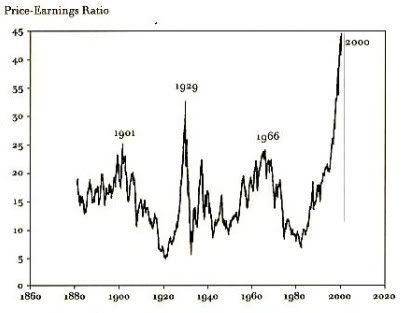
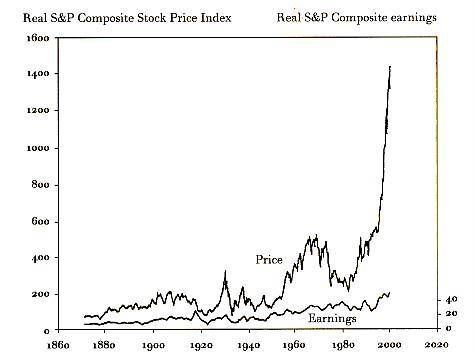
Yes, Spot does. After all, a corporation's worth is really based on what it earns. Stock prices deal with expectations about earnings, but those expectations have gotten way out of whack. Consider a couple of graphs from Robert Shiller's Irrational Exuberance, published in 2000:


It kinda goes off the chart at the end there, doesn't it Spot?

Yes. These data only go through 2000, but the situation today is much the same as 2000.

What's going to happen, Spot?

That's the sixty-four dollar question, grasshopper. Here's what James Kunstler had to say recently:

     With gasoline prices still skulking in the neighborhood of $3-a-gallon, despite oil priced above $80-a-barrel, political and economic leaders can pretend a little while longer that things are okay on the real life American scene. But between the dollar tanking in response to the Federal Reserve's Easy-Money-for-Big-Players policy, and the start of the home-heating season, you can be sure we are headed up to the $4-a-gallon range for happy motoring fuel before New Years.

     There is still broad disagreement among commentators as to whether we are headed into a wild inflation or a grim deflation, but the emerging pattern looks to me like a big ocean wave that gathers itself into a high cresting peak and then collapses under its own weight -- that is, a technical wild inflation resolving into the low slop of people unable to buy anything. However you cut it, and from whatever angle you look at it, the bottom line will be a steeply lower standard of living for most Americans.

Bruce and Techno, Spot thinks this will also affect the militarism of the United States, but it could go either way.

Thursday, October 04, 2007

Katie, this is Janet

You all know Katie, boys and girls. You know Janet, too, if you have been reading SCSU Scholars or Spot's comments about Janet and the Gathering of Eagles.

Where to begin? Okay, we'll start with Katie's column on the bicycle mob. Katie is really cheesed because the cops don't wade in a break some heads during the monthly Critical Mass ride:

Now we know who's in charge of Minneapolis streets. It's a loosely organized group of serial lawbreakers called Critical Mass. Last Friday, 600 or so took over city thoroughfares, breaking traffic laws with impunity while police stayed in the background.

Every month, Critical Mass cyclists ride through rush hour traffic in cities across the country. Some insist the ride is just a "celebration." Others acknowledge a political agenda: they want to enlighten the rest of us -- greedy capitalists that we are -- about the joys of bike riding so we can join them in saving the planet.

We really do have trouble, right here in River City, boys and girls, because:

Are you rushing to catch the last few innings of your son's baseball game?

Trying to get to the show you promised your wife for her birthday?

Critical Mass doesn't give a rip. Tough luck for you, Mac, because you're a gas-guzzler and I'm living green.

Katie, Spot knows that bicyclists are such a pain whenever you're out in your Lincoln Navigator and talking on the cell phone, but did it ever occur to you that the people on bikes are just lobbying for their own little spot in the sun? Because most encounters between the gas guzzlers and bicyclists end up like this:

So, Katie, maybe the Critical Mass rallies will penetrate you consciousness and make you be a little better about sharing the road. Nah. Who is Spot kidding?

This is where Janet comes in Katie. Maybe she could get a contingent of the Gathering of Eagles to, er, police the next Critical Mass outing. These guys and gals like to break heads:

Want to know how an incredibly unpopular radical faction whose leader claims autocratic sway over a population that despises him plans to stay in power? By brute force, what else? Right now, they're employing brownshirt-style "private" thug bands to intimidate – and beat up – critics of the regime's criminal war. Soon – after some "security incident" or another, real or concocted – we will see military troops (and those contract militias, of course) on the street, taking over from the thugs.

You think "it won't happen here?" Wake up and smell the bilgewater, Sparky; it's already happening. As AfterDowningStreet reports, just three days after a gang from the militarist group "Gathering of Eagles" (better known as "Bootlickers of Power") physically attacked the father of an American soldier who was killed in Iraq, the Leader himself had the top henchmen of the group join him for breakfast on the White House lawn. As the picture shows, Bush went out of his way to give the touchy-feely treatment to Bootlicker Chris Hill, who took part in the vicious attack on Carlos Arredondo at an anti-war protest in Washington, D.C. last month.

It is hard to overstate the significance of this presidential embrace. Sure, one might argue that Bush himself had no idea what the Bootlickers were doing, in his name, at the protest. (Although when it comes to anything that augments his power, inflates his self-esteem and punishes his enemies, Bush usually displays an intimate, detailed grasp of the subject.) But it is certain that Bush's minions and handlers in the White House knew exactly what Hill and his fellow Bootlickers had done. Their "liberation" of a picture of Arredondo's dead son from his "peacenik" father was trumpeted loudly through the rightwing media; the Bootlickers were lauded as heroes for this bold action. And the White House knew exactly what it was signaling – and to whom – when it arranged this special honor and photo op for the Bootlickers: "Well done, thou good and faithful servants! Let's see more of this!"

Janet, of course, is down with the Gathering of Eagles:

Anarchist anti-war protestors spray-painted the steps of the US Capitol in January. Another anti-war protest being organized by a coaltion [sic] of radical leftist and anarchist groups is "gathering near the Vietnam Veterans Memorial" on March 17th.

Although the organizers deny any intention to "defile" the Memorial, I will be joining A Gathering of Eagles, which plans to be present to protect the Vietnam Veterans Memorial.

So you see, Katie, what you need to do is import some thugs. W would undoubtedly approve.

Wednesday, October 03, 2007

Rape and pillage

Some neighborhoods in Minneapolis and elsewhere—including Spot's hometown, Edina—have been ravaged by speculator-developers who come in, buy a city-sized lot, "scrape" it, and put a huge, awkward, McMansion in its place. These people have no concern for the nest they are fouling, because they won't live there—or next door. And much too often, city councils fiddle while the neighborhood burns.

Official inaction has fueled a lot of citizen anger. In Minneapolis, there was a campaign that resulted in some changes in the zoning ordinance to prevent the phenomenon called "massing." Richard Moe describes it in his op ed piece in the Strib this morning:

But while visitors [here for a convention on historic preservation] may not notice it, something else is happening here, and it's not good. Residents who care about this place have every right to pat themselves on the back for their preservation achievements in recent years -- but they must see that big, important chunks of their heritage are still in danger of being spoiled or lost altogether.

Take the riverfront, for example. The rediscovery and ongoing revitalization of this attractive and history-rich area is one of the best things that's happened in this city in my lifetime. But now there's a very real possibility that the rebirth of this long-ignored enclave could destroy the very qualities that make it appealing. Almost every week brings an announcement of a splashy new construction project, and too many of them are too big, threaten to block views of the river, consume precious open space, and otherwise overwhelm the scale and character of the area. The riverfront's popularity shouldn't be allowed to strangle it just as it's coming to life. It may be a truism, but it's worth remembering: You can't revitalize a neighborhood by destroying it.

That same statement has a special resonance in neighborhoods that are experiencing tear-downs. This practice of demolishing an existing house and replacing it with a bigger one is the most serious threat faced by older neighborhoods since the heyday of Urban Renewal, and it has hit the Twin Cities hard. Recent Star Tribune articles describe a "citizen revolt" in embattled neighborhoods in southwest Minneapolis, Edina and Minnetonka -- and no wonder: Mini-mansions get awkwardly shoehorned into established communities where they just don't fit. As bulky new structures get built right up to the property lines, trees disappear and yards shrink, and neighbors find their sunlight and views blocked. Economic and social diversity are reduced as rising property taxes drive out moderate-income or fixed-income residents and affordable "starter homes" disappear. Historic character gets smashed to rubble and hauled off to the landfill. [italics are Spot's]

Smashed to rubble and hauled off to the landfill. That's a pretty accurate description of what is happening. Now, Spot has heard about a neighborhood in Edina that is rising in anger over another rending of the community's fabric. They've produced a really good video that the city council apparently refused to watch last night:


Spot says make some noise about this boys and girls, before it happens on a lot near you.

[update] Spot should probably mention that Richard Moe is also the author of The Last Full Measure, an account of the heroic First Minnesota Regiment during the Civil War. [/update]

Huffing and puffing

Do you remember, boys and girls, when Professor Banaian got all testy about someone (well, it was Charlie at Across the Great Divide) questioning whether ISPs should be permitted to censor messages? The King drew himself up and thundered "They are private businesses!" Spot commented on Charlie and the King's discussion in ISPs as utilities. The issue of censorship of messages on what amount to common carriers is a very real one. Here's another example:

On the face of it, last week’s brouhaha over Verizon’s censorship of NARAL appears to be the result of a simple corporate bungle, an “isolated incident” caused by a misinterpretation of “a dusty internal policy,” as corporate spokespeople put it. But behind this corporate snafu is an unhappy marriage of two much larger issues.

Thousands grew outraged last week when Verizon threatened to censor their private communications. Expert Lea Shaver of Yale Law School’s Information Society Project reports that advocates of legislation designed to prevent censorship on the net have been concerned about the censorship potential of Verizon’s internal policies for some time but were dismissed as paranoid. Verizon is also a principal sponsor of the key corporate interest group opposing such legislation.

The King is so busy worshipping at the altar of his tin god "the market" that he is blissfully unaware of the erosion of his political freedoms, including especially freedom of speech. Pity.

Related is the whole issue of 'net neutrality:

Common Cause firmly believes in net neutrality -- the  principle that Internet users should be able to access any web content they want, post their own content, and use any applications they choose, without restrictions or limitations imposed by their Internet service providers (ISPs).

Net neutrality is the reason this democratic medium has grown exponentially, fueled innovation and altered how we communicate.  We must make certain that for-profit interests do not destroy the democratic culture of the web.

When a private company can acquire right of way, a license to use public airwaves or bandwidth, or some other right granted by the government, it is not merely a "private business" any longer. It has public responsibilities for the authority granted to it. This is a proposition so simple that only an economics professor doesn't seem to understand it.

Tuesday, October 02, 2007

The King is cranky!

King Banaian missed his bagel klatch this morning, and he's clearly miffed. He drove his eighth-grade daughter to school, and then he had to drive back home for something she forgot:

This morning Littlest Scholar heads out the door to the car, checks the back seat to see that her football is in tow, and upon arriving to school tells me her diorama she had made last night had been forgotten at home. It must be brought now. Because of road and bridge construction, it takes me forty minutes to go home, retrieve the diorama and bring it to school.

This caused me to miss my normal bagel-and-coffee with friends. Should I charge her for this?

Of course you should, King! Children should be raised in as close to Skinner box conditions as possible. Spot is sure you have a pretty comprehensive scheme of carrots and sticks for raising your daughter anyway, King; Spot is surprised that you have to ask the question. It is apparent, however, that the professor's pique was compounded later in the morning when he got this message from his daughter's teacher:

Would you please be able to get (her) to school a few minutes earlier in the morning? We start our day at 7:40, and that has been when she has walked in the door the last few days. Maybe about 7:35 or so. Thanks very much.

What cheek! Imagine, a mere teacher asking his majesty the King to bring his daughter to school on time. Obviously, this was an affront to economics professors everywhere. So the King did what an economics professor would do: turn the fact that he can't get his arse out of the rack in order to get his daughter to school on time into a economics problem:

I'm a bit tempted to be flip with the teacher (who, btw, sent this at 7:45, so whatever was being done right at 7:40 didn't require his [Katie look: a male teacher] full attention.) After all, the bridge construction has changed traffic flows three times in the last four weeks, and predicting the time to leave the house to have her arrive at 7:35 is an estimate with much greater uncertainty now than in time passed [sic]. So I decided to reflect a little economics on the problem.

The teacher is undoubtedly lucky that Banaian managed to tamp it down! What follows is Banaian's description of the incentives that bear on his getting his daughter to school early (apparently bad, if too early), late (also bad, which seems to mystify, or at least disquiet, the King), or just right: a few minutes before the opening bell. One of the disincentives to be timely is this:

Indeed, since the school sends me a note equally for bring the child early or late, the credit I get for a 7:25 arrival is zero. Maybe something closer to 7:32 might bring a smile, hardly enough payment for forgoing that last article in the sports pages with my breakfast.

It's a mind bender to the King that the teacher would be so tedious about wanting students to be punctual.

Professor, if you're having breakfast, you don't need that bagel a little later, anyway.

Boys and girls, the professor has given us a splendid example of the difference between a responsible adult and one who has to be bribed to do anything.

Monday, October 01, 2007

Holding self esteem in low esteem

Anyone with a passing acquaintance with Katie's scribblings—and that's all Spot can recommend: a passing acquaintance; Spot's talking to you, Gump—knows that Katie is capable of writing a column without the smallest cognition that what she is writing is contradictory to what she wrote before. It is a charming quality that infuses Katie's writing in a memorable way. We have a nice example of the genre in Katie's column today: Shortage of male teachers shows need for truly wise guys.

Katie's lament de jour is the dwindling number of male teachers in elementary school. Why, they even have trouble finding men to teach at one of Katie's pet charter schools:

Finding male teachers is a challenge even at Boys Academy, a special program of Harvest Preparatory School, a K-6 charter school in Minneapolis. Boys Academy's student body is 100 percent African-American and about 80 percent from low-income families. Its faculty is 40 percent male, and all female teachers have a male classroom aide. But Eric Mahmoud, the school's president, says it's very difficult to find men to apply to teach kindergarten or first grade.

Why the school's Muslim president would talk to the anti-Muslim and xenophobic Katie, Spot has no idea. But never mind.

Katie goes on to say how difficult it can be to teach boys, the little barbarians:

Boys can be the bane of elementary teachers' existence. They are high-energy, impulsive and easily distracted, and have been ever since Cain clobbered Abel. Most would rather wrestle than trace letters at a desk.

Apparently, it's an original sin kind of a thing. Figures. Spot thinks that the boys were mean to Katie when she was in the third grade. What do you think, boys and girls?

Anyway, Katie does write with admiration about one male teacher at Harvest Prep, Erick Owens, who teaches third grade. And certainly based on Katie's description of Mr. Owens, he does sound like a very good teacher. Here's one of Katie's explanations:

Owens understands how to channel boys' energy because he was once a boy himself.

That's it! Why has no one ever thought of this before? Why, Spot remembers being eight or nine years old like it was yesterday! (It wasn't.)

Spot, we thought you said that Katie had written something contradictory. What is it?

Oh, thank you grasshopper. Here's the money quote. This is what Owens does sometimes:

He takes pains to keep the competition relatively equal. "If one team's behind, I give them a question that's worth more points so they feel good and keep trying."

Can you imagine that? He keeps the self esteem of his kids in mind? That's no way to raise social Darwinist hunter gatherers! Katie has put this self esteem nonsense in its proper perspective before; Spot has commented here and here (they are two posts that Spot really liked, by the way; he hopes that you'll check them out) about a couple of Katie columns on the subject where she wrote this:

Years ago, my daughter, then [in] second grade, jumped off the school bus one day with a badge pinned to her shirt. "[Blank] is special," it said, with her name filled in. But my daughter wasn't busting her buttons. "Mom," she told me, "if everyone is special, then no one is special."

Young as she was, my daughter grasped that there is something bogus about the self-esteem movement, which was then taking the education world by storm.

Katie, you must go back to Mr. Owens and explain to him that the only way to encourage children is to punish them when they don't do well.

Sunday, September 30, 2007

Spot won't even try to summarize this one

But the title says it all:

Prosecuting Blackwater - A Brief Tour of the Law by David Luban at Balkinization.

Baked or fried?

How would you like your crow served, Mr. Friedman? Tom "Suck on This" Friedman wrote a column in the Sunday NYT wherein he admits that 9/11 made him stupid:

What does that mean? [the continuous waving of the bloody shirt] This: 9/11 has made us stupid. I honor, and weep for, all those murdered on that day. But our reaction to 9/11 — mine included — has knocked America completely out of balance, and it is time to get things right again.

Well, not everybody, Tom.

Anyway, Tom yearns for the good old days when we just worshipped at the feet of his little tin god: globalization:

I’d love to see us salvage something decent in Iraq that might help tilt the Middle East onto a more progressive pathway. That was and is necessary to improve our security. But sometimes the necessary is impossible — and we just can’t keep chasing that rainbow this way.

Look at our infrastructure. It’s not just the bridge that fell in my hometown, Minneapolis. Fly from Zurich’s ultramodern airport to La Guardia’s dump. It is like flying from the Jetsons to the Flintstones. I still can’t get uninterrupted cellphone service between my home in Bethesda and my office in D.C. But I recently bought a pocket cellphone at the Beijing airport and immediately called my wife in Bethesda — crystal clear.

I just attended the China clean car conference, where Chinese automakers were boasting that their 2008 cars will meet “Euro 4” — European Union — emissions standards. We used to be the gold standard. We aren’t anymore. Last July, Microsoft, fed up with American restrictions on importing brain talent, opened its newest software development center in Vancouver. That’s in Canada, folks. If Disney World can remain an open, welcoming place, with increased but invisible security, why can’t America?

We can’t afford to keep being this stupid! We have got to get our groove back. We need a president who will unite us around a common purpose, not a common enemy. Al Qaeda is about 9/11. We are about 9/12, we are about the Fourth of July — which is why I hope that anyone who runs on the 9/11 platform gets trounced.

Spot has some really bad news for you Tom. After we start a war with Iran, we may never get back to your little nirvana.

Juan Cole also comments on Friedman's apparent mea culpa.

Saturday, September 29, 2007

Ok people, let's get some stuff straight

It has been reported by Eric Black and Joe Bodell at Minnesota Campaign Report that Mayor Jim Hovland of Edina may enter the the 3rd District race as a DFLer. Here's a bit from Eric yesterday (Friday):

James  B. Hovland, the Republican mayor of Edina, will be switching to the DFL and is seriously contemplating entering the race for the Dem nomination for the open Third District congressional seat.

Hovland will be meeting with representatives of the Democratic Congressional Campaign Committee shortly (possibly tomorrow) to get acquainted and talk about the race.

Spot says this is really, really good news. Hovland is a stand-up guy who would fit and represent the 3rd District very well. He is well liked by his constituents (including Spot) and a leader among area mayors. He is the kind of candidate who could turn the 3rd blue. Hovland is a public-spirited and pragmatic mayor of a community of nearly 50,000.

As part of the Edina City Council, Mayor Hovland opposed the adoption of "conceal and carry" handgun legislation. He is, Spot believes, pro-choice. He has been a persistent critic of the governor—and the governor's claque, including Geoff Michel—on transportation and the gas tax. Here is an op-ed in the Strib by Jim Hovland a couple of weeks ago:

James B. Hovland: A conflict at the helm of MnDOT?

The head of a state agency must have priorities that may not mesh with one's more-political alter ego as lieutenant governor.

James B. Hovland

Published: September 14, 2007

In the aftermath of the Interstate Hwy. 35W bridge tragedy, Minnesotans remain grief-stricken and bewildered. We have little choice but to wait patiently for forensic experts to determine the exact cause of an event that has shaken our confidence in state government. Minnesota was once highly regarded for its diligence in protecting the public health, safety and welfare; restoring lost confidence should be our state's highest priority. But how?

Gov. Tim Pawlenty has made a good start by ordering inspections of all bridges of the same type as the failed bridge and taking inventory of all the state's bridges, perhaps with an eye toward raising standards for bridge evaluation. But two broader questions are as relevant and cannot be swept aside:

• Do we Minnesota voters have the collective financial fortitude to demand that all of our state elected leaders finally make the transportation commitments needed to keep us safe and competitive in the future? After two decades of falling behind, let's hope the vivid memory of a fallen bridge prompts our governor and Legislature to build a financial strategy that actually achieves the sound and wise transportation system that we and future generations need.

• Is it wise to have a statewide elected official, in this case the lieutenant governor, also in charge of running a state agency, in this case the transportation department? Should Carol Molnau be running MnDOT?

Under state law, the commissioners of departments operate within the executive branch as direct hires of the governor. While the governor is a commissioner's boss, commissioners are also charged with advocating for the best interests of citizens, as those interests relate to a particular agency. State law requires our transportation commissioner, for example, to develop, adopt, revise and monitor a statewide transportation plan in order to "provide safe transportation for users throughout the state" and "to provide funding for transportation that, at a minimum, preserves the transportation infrastructure."

But when a governor and lieutenant governor are politically aligned, and that lieutenant governor also runs MnDOT, such political kinship runs the risk of diminishing the commissioner's sworn role as a transportation advocate. Bluntly, does Tim Pawlenty have in his Cabinet a commissioner who will speak expertly and frankly about the transportation needs of the state? Does he have someone who will offer advice he may not want to hear about the sufficiency of revenues to effectively repair and expand our system of roads, bridges and transit?

The image etched in my mind is from last spring: the governor, flanked at a news conference by his hybrid lieutenant governor/MnDOT commissioner, with a flourish of his pen, vetoing a transportation bill that would have set Minnesota on a course to repair and expand its infrastructure. Only a minimal "lights on" budget was left. And the lieutenant governor just stood there, smiling.

James B. Hovland, mayor of Edina, is cochairman of the Regional Council of Mayors and is a member of the Transportation Advisory Board to the Metropolitan Council.

Spotty knows that the mayor has been one of the initiators of efforts to make Edina a more transit-friendly, pedestrian-friendly, and bike-friendly community. And a greener place, too.

Somebody who calls himself MNMark left this comment on the MNCR post about Hovland's party switch and possible candidacy:

Gee, just what we need, another phony 'Democrat'.  At least this one has the excuse of having actually been a Republican unlike all those that have pretended to be Dems.

And if he should actually win the seat will be all be surprised when he votes just like Ramstad?  And this will be an improvement because he is 'Ramstad(D) instead of Ramstad(R)?

Thanks, I'll pass.

Spot says to give the mayor another look, MNMark. Spot says that the 3rd will elect a moderate, and Jim Hovland is a good one. He matches up very well against, say, Erik Paulsen.

Spot, for one, hopes that Jim Hovland enters the race.

Friday, September 28, 2007

The power of positive thinking

Nick Coleman's column today was about "crumbling bridge" terminology. Ever since the article in the Strib a few days ago about how current engineering terminology like "structurally deficient" was scaring the public, Spot has been thinking about how the Pepsodent administration would try to soften the blow. Nick Coleman told us how this morning in Faith-based bridges:

The Minneapolis bridge was one of 70,000 "structurally deficient" bridges in the country that Americans have worried about. So government officials are going to make us stop worrying. Not by fixing bridges -- that would cost billions -- but with smoke and mirrors and baloney.

Here's their idea: Change the terms. State highway officials want engineers to stop scaring us with spooky labels. You may have thought it was the sight of cars in the water and crying people trapped under tons of concrete and twisted steel girders that scared us. Nope. It was the terminology.

So our highway departments have rolled up their sleeves and, with American know-how and a "can-do" attitude, have begun a rebranding effort to lull us back to sleep.

No more unpleasant labels such as "structurally deficient." We need something soothing.

I suggest calling them "Ready For Rapid Gravity Removal" bridges. That's what happened to our "structurally deficient" bridge. It fell down. And it killed people. Or perhaps I should say, it lowered itself into a river and some citizens were inconvenienced.

Brave leaders, including Gov. Tim Pawlenty and Lt. Gov. Carol Molnau, who also serves as Boss of Highway Construction, have done little more than pose for pictures while avoiding responsibility and robbing money from other overdue and underfunded highway projects to try to pony up the front money for a new I-35W bridge. They can't keep the state highway headquarters from falling down, but they are re-engineering English.

They have priorities.

One brave new wordsmith at MnDOT asked this: If car dealers call used cars "previously owned," why can't we find a term for "structurally deficient" that isn't unpleasant?

And as Nick points out, new terminology is much cheaper than actually fixing the bridges! It's that kind of innovation that will propel Governor Pepsodent far in his quest for national office, or at least a Republican nomination.

Spot was sure he had a John Ralston Saul quotation on the subject in the computer here somewhere, but he can't find it. Maybe later.

Meanwhile, there are interesting developments out here in Cakeville, boys and girls, about which Spot will have more to say later.

Thursday, September 27, 2007

ISPs as utilites

Charlie at The Great Divide and the King at SCSU Scholars have been conducting a regrettably civil discussion on the subject of the effects of government versus corporate action in restraining civil liberties such as free speech. Here's a bit from Charlie:

The King and I have a bit of a back and forth going in the comments section which I have left there in case it is getting too off in the weeds. I have little enough interest in my own arguments, so I don't expect you to show up and cheer for my increasingly esoteric points.

But still, a little more.

What King and I have both done is restated the other's arguments in ways with which the speaker doesn't agree. I did it with this:

But I find it extremely comical that an economist can overlook how corporations enjoy the protections of government — particularly through lobbying, political back scratching and the courts.

Then King responded:

Good heavens, no. I don't overlook it. I call it "rent-seeking" and I abhor it. [NOTE: Don't bother clicking on his link unless you have 10 bucks or you're an academic with a JSTOR account.] Economists have long recognized its existence and the inefficiency of it. Where Charlie and I might disagree is how to cure it.

And he returned the favor:

He would argue that there are not enough government restrictions on economic activity and seek political solutions to put more on.

And here's a little bit from King "free the money" Banaian in a comment to the post:

I will also note that AOL or any other ISP is under no obligation to provide you a forum for your political views, and this was the original point. They are engaged in commerce.

The whole thing started, apparently, because some liberal/progressive organization's blanket emails were being blocked by Charlie's ISP. The King, of course, find this perfectly acceptable because, as the King puts it, because the ISPs are "engaged in commerce." Well, that explains everything! Charlie, Spot doesn't know how you're still standing after that withering broadside!

Of course, if you follow the King's foolish argument to its logical extension, railroads could decide to limit or arrange their stops to limit some of their carriers' competition; telephone companies could decide not to provide service to some customers because they were just too much trouble; gas and electric utilities could do the same.

 Spot wants to quote John Ralson Saul (again) discussing the fate of another quasi-utility: television. Here's Saul writing in the early 90s:

The invention of the video cassette seemed to create a new element of freedom. A cassette is no more difficult to smuggle or hide than a book. Now, even in the most restrictive dictatorships, the elites who travel abroad return with cassettes. But only people rich enough to travel and to own a VCR are involved; people rich or powerful enough to ensure that they can watch the cassettes in absolute privacy.

The blatant controls enforced in some countries encourage us to think that the problem does not apply in the West. Yet in some ways our problem is worse. Nothing can appear on any of our screens without large inputs of cash from either advertisers or governments. Almost from the beginning the advertisers understood that, while they could not dictate content, it was easy to block whatever they didn't want on the air. All they had to do was not advertise it. Attempts by some networks to disarm this, pressure by selling block advertising not assigned to specific programs has tended simply to obscure the problem by forcing advertisers to be more subtle when they apply pressure. The intelligent master never forbids. He shapes things in order to avoid undermining his own interests and to avoid open conflict. Television advertisers understand this and have therefore become the champions of inconsequential entertainment.

Meanwhile, throughout much of Europe, government fenders understood from the beginning that they held controlling power. The result — in contrast to the early freedom on public television in a few countries such as the Netherlands, Britain, Germany, Canada and Australia — was organized propaganda, sometimes subtle, sometimes not. But even those few arm's-length governments gradually tired of being criticized by state corporations which exercised electronic free speech. Politicians began to respond with clumsy personal attacks on specific television programs and journalists, accusing them of antigovernment bias. This approach tended to backfire because it reminded the public of the 1930s, which had begun with governmental righteous indignation against free speech and ended with dictatorships across Europe. Governments therefore turned to bureaucratic manipulation. Budget restraints and political appointments proved so effective that producers soon understood there was little or no funding for real and sustained criticism. That was already the situation on private networks.
This atmosphere gradually created self-censorship, first among management and then among senior production staff. They found them selves becoming ever-more careful and ever-more "balanced," until they began to take extreme "care" each time a public issue arose.

But those who hold power already have an advantage over both the opposition and the press, which is why serious journalists have always tended towards a critical approach which seeks out faults. Governments and corporations have budgets and experts permanently assigned to the preparation of arguments designed to contradict all unfavourable judgments. These professional answers, when placed in opposition to most criticism, will at least create confusion and, at their most successful, cancel out the effect of the attack. Rigorous balance, when applied to television, gives a permanent advantage to those in power.
Nevertheless, budgetary and political manipulations are a complicated way to control freedom of speech. The solution has therefore increasingly been to commercialize television. After all, what attracts advertisers to television is precisely its ritualistic, reassuring smoothness.

Shocking and unsettling programs do not provide an effective background for marketing products. Distinctive programming detracts from, the surrounding ads. What the sponsor seeks can be seen in the fact that ads are played at a higher sound level than the programs. On a scale of one to ten, programs vary from occasional silence to moments of maximum noise, but they run at average levels of four to six. Commercials are recorded at seven to eight, well above the program average. And while program sound fluctuates, ads hold a constant level for thirty seconds. This makes them seem even louder. The more commercial the overall television system, the more these ads tend towards eight or nine, as in the United States. But even at seven they are the dominant sound.

Ritual is a continuous and repetitive background phenomenon. Thus most programming is the background for commercial messages. The per-second production costs — what the industry calls "production values" — of advertisements are far higher than those of programming. In fact, most commercials are better television than the programs they finance, thanks to richer colour, more camera work and snappier scripting. If there is some benefit to be derived from dramatic surprise, it is saved for the advertiser.

Television networks are all about commerce, too. The network executives may have a political point of view, but part of what they are interested in is just making the whole thing run smoothly and avoiding controversy and maximizing their return. The same thing is true with the ISPs.

And that, boys and girls, is why is is foolish to think that private business will ever look out for the public weal. Some activities are so important and so necessary that we must ensure their access to all citizens. We call these things utilities. Spot cannot go out an find another gas company, nor is there much practical choice among the ISPs in the present climate.

Colorado Katie & the Norwegian Kid

Spotty, you can sure tell that Katie spent some time on a dude ranch recently.

Oh, how, grasshopper?

Well, remember on Monday how she wrote about her reunion with her college, er, chums on a Colorado ranch?

Yes, so she told us that she had been on a ranch.

Gosh, you're right, Spotty! But that isn't what I meant. What I meant was her column today. It is full of ghost towns, tumble weeds, and this:

Why is the moderate Republican ghost town emptying out? The mythmakers claim it has a sheriff -- a mean, low-down hombre with a glint of religious zealotry in his eye.

He and his posse threaten to string up any candidate with a streak of independence if he doesn't clear out of town.

I wonder if she is still wearing that ridiculous fake cowboy hat in the newsroom?

Probably. Katie's offering today was about her claim that the Republican party has more moderates that the Democratic party. And just as Gump predicted at Suddenly South, the column contained some pearl clutching over the MoveOn.org ad criticizing General Petraeus.

Rather than waste any more of what promises to be a really nice day, Spot is just going to send you over to Norwegianity to see what the Wege has written about Katie's column today.