Saturday, October 07, 2006

News Flash!

The Oakland A's players apparently have families, too! Katie told us yesterday that even though the local boys' backs were against the wall, we would win because we had families.
Obviously, the Twins are big advocates of the family-first principle.
The wives say that one of their most important roles is
counselor-in-chief -- cheering the ups and being there for the downs.

You know, Spot thinks that backslider Joe Mauer is single. Better trade him in the off-season.

Friday, October 06, 2006

Hey Katie!

You'll be interested in this. Remember when you gushed about how good things were going to be for the Christians in Iraq after Saddam's toppling? Well, you're early report was apparently greatly exaggerated.

Link from Informed Comment.


Technorati Tags: ,

Thursday, October 05, 2006

Before and After

Here is section 2241(e) of title 28 of the United States Code (there are actually two of them, apparently because of some frantic drafting that went on with the Detainee Treatment Act of 2005, the last time that John McCain folded like a cheap umbrella) before the Military Commissions Act of 2006:

(e) Except as provided in section 1005 of the Detainee Treatment Act of 2005 [10 USCS § 801 note], no court, justice, or judge shall have jurisdiction to hear or consider--

(1) an application for a writ of habeas corpus filed by or on behalf of an alien detained by the Department of Defense at Guantanamo Bay, Cuba; or

(2) any other action against the United States or its agents relating to any aspect of the detention by the Department of Defense of an alien at Guantanamo Bay, Cuba, who--

(A) is currently in military custody; or

(B) has been determined by the United States Court of Appeals for the District of Columbia Circuit in accordance with the procedures set forth in section 1005(e) of the Detainee Treatment Act of 2005 to have been properly detained as an enemy combatant.

[(f)](e) Except as provided in section 1405 of the Detainee Treatment Act of 2005 [10 USCS § 801 note], no court, justice, or judge shall have jurisdiction to hear or consider--

(1) an application for a writ of habeas corpus filed by or on behalf of an alien detained by the Department of Defense at Guantanamo Bay, Cuba; or

(2) any other action against the United States or its agents relating to any aspect of the detention by the Department of Defense of an alien at Guantanamo Bay, Cuba, who--

(A) is currently in military custody; or

(B) has been determined by the United States Court of Appeals for the District of Columbia Circuit in accordance with the procedures set forth in section 1405(e) of the Detainee Treatment Act of 2005 to have been properly detained as an enemy combatant.

Here is how these sections will read after the amendments contained in the Military Commissions Act of 2006:

(e)(1) No court, justice, or judge shall have jurisdiction to hear or consider an application for a writ of habeas corpus filed by or on behalf of an alien detained by the United States who has been determined by the United States to have been properly detained as an enemy combatant or is awaiting such determination.

(2) Except as provided in paragraphs (2) and (3) of section 1005(e) of the Detainee Treatment Act of 2005 (10 U.S.C. 801 note), no court, justice, or judge shall have jurisdiction to hear or consider any other action against the United States or its agents relating to any aspect of the detention, transfer, treatment, trial, or conditions of confinement of an alien who is or was detained by the United States and has been determined by the United States to have been properly detained as an enemy combatant or is awaiting such determination.

Wow, what's this all about, Spotty?

Oh, sorry grasshopper, this is language from the United States judicial code relating to the writ of habeas corpus. The subsections of section 2241 prior to (e) address the grant of the writ, procedure for application for it, etc. Incidentally, Spot could only get the old language from Lexis, which he cannot link to, and the new language is from a pdf that somebody sent to Spot, so there are no links to provide for the old subsection (e) or the new, sorry.

What follows leans heavily on what was written by Spot in Dissing the Great Writ and Dissing the Great Writ II. You might want to read those posts if you haven't already.

The old language is pretty well, amateurish, compared to the new. While the old language removed court jurisdiction only for habeas corpus petitions for prisoners at Guantanamo Bay detained by the Defense Department, the new language covers any detention by any agent of the US anywhere. (Think secret CIA prisons that the administration told us didn't exist until the fact of their existence was leaked.) The only two conditions are that the person (only aliens or permanent resident ("green card") aliens) be "properly detained" as an enemy combatant or "awaiting such determination."

These status determinations are made pursuant to the Detainee Treatment Act of 2005 passed in the wake of Hamdi v. Rumsfeld.

One issue that is interesting to Spot is whether our present circumstances warrant the invocation of the Suspension Clause:

The privilege of the Writ of Habeas Corpus shall not be suspended, unless when in Cases of Rebellion or Invasion the public Safety may require it.

Article I, Section 9, Clause 2, US Constitution.

Did the attacks of September 11, 2001 amount to an "invasion," and if so, when will we be un-invaded?

Update: There are of course also detention centers in Iraq and Afghanistan currently holding thousands of detainees.

Tags:

Tuesday, October 03, 2006

This just in!

Spot hasn't had a chance to study it in much detail yet, but it does appear that the provisions of the Military Commissions Act of 2006 related to trial before the commissions and limitation of habeas corpus as sent to the President will only apply to non-citizens. More later.

John Yoo Malpractice Remediation Act of 2006

Spot wondered how John Yoo would skate on his advice when, as a Justice Department lawyer, he authored the advice to the administration that the Geneva Conventions' prohibition of torture were somehow inapplicable to detainees in the warron terra. In a memorandum to the general counsel of the Department of Defense, co-authored by now St. Thomas Law School professor William Delahunty, these two bright lights opined that the United States, and the administration of George Bush in particular, were not bound by Common Article 3 of the Geneva Conventions in its treatment of the Taliban and al Qaeda.

Oops.

Guess you and Bob were wrong, John! In Hamdan v. Rumsfeld, decided this summer, the Supreme Court held that Common Article 3 did apply to the Taliban and al Qaeda. This is such a bummer on so many levels! Not only does the administration now have to go through the motions of pretending to make fair tribunals available to detainees, all the people right up and down the line—including way up—who approved the torture of these detainees are war criminals!

A lot of these people are going to be plenty pissed at you John. And we already know what they are capable of. What's that John? We should amend section 2241 of the federal criminal code, the War Crimes Act, to get rid of that pesky reference to Common Article 3?

Sounds good, John, but we can't do that entirely. You know as well as Spot does that that making domestic crimes out of our Geneva Convention obligations is a part of those obligations. How about this?

We amend the code to say that only "grave breaches" of Common Article 3 are crimes, make it retroactive, and then provide that the president can decide what grave breaches are? Works for you? Good. That should take care of a lot of people. No so many people mad at you now.

Of course, like Henry Kissinger, these people will not be able to travel abroad for the rest of their lives for fear of being arrested and charged with war crimes. Hope you don't have any big travel plans John.


Tags: , ,

Monday, October 02, 2006

Dissing the Great Writ II

Dissing the Great Writ is the introductory course, boys and girls. Read it before you read this post. Now we return to the opinion in Ex parte Mulligan.

One of the government's arguments to support Mulligan's trial before a military commission was that the country was under martial law during the Civil War. The Court's reply was Oh? Not by a long shot. Here's another part of what the Court wrote:

The discipline necessary to the efficiency of the army and navy required other and swifter modes of trial than are furnished by the common law courts, and, in pursuance of the power conferred by the Constitution, Congress has declared the kinds of trial, and the manner in which they shall be conducted, for offences committed while the party is in the military or naval service. Everyone connected with these branches of the public service is amenable to the jurisdiction which Congress has created for their government, and, while thus serving, surrenders his right to be tried by the civil courts. All other persons, citizens of states where the courts are open, if charged with crime, are guaranteed the inestimable privilege of trial by jury. This privilege is a vital principle, underlying the whole administration of criminal justice; it is not held by sufferance, and cannot be frittered away on any plea of state or political necessity. When peace prevails, and the authority of the government is undisputed, [p*124] there is no difficulty of preserving the safeguards of liberty, for the ordinary modes of trial are never neglected, and no one wishes it otherwise; but if society is disturbed by civil commotion -- if the passions of men are aroused and the restraints of law weakened, if not disregarded -- these safeguards need, and should receive, the watchful care of those intrusted with the guardianship of the Constitution and laws. In no other way can we transmit to posterity unimpaired the blessings of liberty, consecrated by the sacrifices of the Revolution.

It is claimed that martial law covers with its broad mantle the proceedings of this military commission. The proposition is this: that, in a time of war, the commander of an armed force (if, in his opinion, the exigencies of the country demand it, and of which he is to judge) has the power, within the lines of his military district, to suspend all civil rights and their remedies and subject citizens, as well as soldiers to the rule of his will, and, in the exercise of his lawful authority, cannot be restrained except by his superior officer or the President of the United States.

If this position is sound to the extent claimed, then, when war exists, foreign or domestic, and the country is subdivided into military departments for mere convenience, the commander of one of them can, if he chooses, within his limits, on the plea of necessity, with the approval of the Executive, substitute military force for and to the exclusion of the laws, and punish all persons as he thinks right and proper, without fixed or certain rules.

The statement of this proposition shows its importance, for, if true, republican government is a failure, and there is an end of liberty regulated by law. Martial law established on such a basis destroys every guarantee of the Constitution, and effectually renders the "military independent of and superior to the civil power" -- the attempt to do which by the King of Great Britain was deemed by our fathers such an offence that they assigned it to the world as one of the causes which impelled them to declare their independence. Civil liberty and this kind of martial law cannot endure [p*125] together; the antagonism is irreconcilable, and, in the conflict, one or the other must perish. [emphasis is Spot's]

Spot apologizes for the density of the Court's writing, but it's kind of lyrical to Spot. Sniff.

So, you want military commissions for whomever the executive orders arrested? Fine, just don't call it the rule of law. Military commissions are a form of martial law. Has civil authority and the court system broken down so badly that martial law must be imposed? On anybody, and just on the executive's say so? The notion is so absurd that there must be a Gilbert and Sullivan patter song about it.

The last time Spot looked, it was six lanes open, no waiting, for the trial of terrorism suspects in civilian courts. Procedures and rules of evidence have existed for a long time to protect information vital to national security.

The Military Commission Act of 2006, at least the House bill that Spotty saw, contained a Congressional finding that the kangaroo courts set up by the Act are in compliance with Common Article 3 of the Geneva Conventions. What absolutely self-serving baloney! The Congress held no hearings, received no expert testimony, and the Republicans didn't even confer with the Democrats about the procedural and substantive sufficiency of the proposed commissions. It was the administration on one side, and Larry, Curly and Moe on the other.

Spot would like to address one last thing. Detention of combatants for the duration of hostilities is really a given. You don't repatriate prisoners of war until the war is over. How do we know when this war is over? There isn't even an enemy to surrender or conclude a cease fire or peace treaty with. What if bin Ladin marched over the hill one day and hoisted a white flag of surrender? Would the war be over then? Is there any limit to how long people can be detained without access to an honest-to-God court to determine if there is any basis for holding them?

Let's be clear: George Bush is a war prezinut only in his own fevered imagination. There has been no declaration of war. It is perilous to civil liberties to permit him to arrogate to himself all of the powers of a war-time commander. The United States has weathered every crisis in its history without granting to the executive all of the powers that George Bush seeks.

Tags: ,

What this blog needs is a billboard


In honor of Spotty's explanation below as to why the Great Writ matters, now more than ever.

Dissing the Great Writ

Habeas corpus is Latin for Bring that sucker here and explain why you locked 'em up. Spot is paraphrasing here. In very general terms, here is how it works. An imprisoned individual, or a person who has standing to petition on his behalf, petitions a court to issue the writ to the person in charge of the prisoner's incarceration. If the writ issues, this person must come to court and defend the incarceration. To request the writ in federal court, the petitioner must allege that his incarceration is unconstitutional.

MNObserver, Spot, and many others have complained bitterly about the impairment of the Great Writ by the recently enacted Military Commissions Act of 2006.

Spotty, is this a big deal?

It is indeed a big deal, grasshopper. Here's a bit from an article by Professor Bruce Ackerman that is linked in the Greenwald post that MNObserver refers to below:

BURIED IN THE complex Senate compromise on detainee treatment is a real shocker, reaching far beyond the legal struggles about foreign terrorist suspects in the Guantanamo Bay fortress. The compromise legislation, which is racing toward the White House, authorizes the president to seize American citizens as enemy combatants, even if they have never left the United States. And once thrown into military prison, they cannot expect a trial by their peers or any other of the normal protections of the Bill of Rights.

This dangerous compromise not only authorizes the president to seize and hold terrorists who have fought against our troops "during an armed conflict," it also allows him to seize anybody who has "purposefully and materially supported hostilities against the United States." This grants the president enormous power over citizens and legal residents. They can be designated as enemy combatants if they have contributed money to a Middle Eastern charity, and they can be held indefinitely in a military prison.

Not to worry, say the bill's defenders. The president can't detain somebody who has given money innocently, just those who contributed to terrorists on purpose.

But other provisions of the bill call even this limitation into question. What is worse, if the federal courts support the president's initial detention decision, ordinary Americans would be required to defend themselves before a military tribunal without the constitutional guarantees provided in criminal trials.

Legal residents who aren't citizens are treated even more harshly. The bill entirely cuts off their access to federal habeas corpus, leaving them at the mercy of the president's suspicions.

This is, of course – well perhaps not of course, but it is – the treatment of Jose Padilla, the so-called "dirty bomber," a citizen who was held in a military brig for over three years.

But didn't Abe Lincoln suspend habeas corpus during the Civil War?

Yes, grasshopper, he did. This is where the going gets a little rough. You might want to go and fill you coffee cup and use the restroom if you need to. Spot will wait.

[reader determined interval]

All set? Good. Abe Lincoln did suspend habeas corpus, at least a couple of times. The first time was in 1861 and covered only the states in rebellion. The second time was in 1862 and covered the entire nation. In the second case, Lincoln's concern was whether or not war protesters, the Peace Democrats or copperheads, would be dealt with by state courts for discouraging enlistments or other "disloyal practices."

It might be useful to stop a moment here and recite what the Constitution says about habeas corpus:

The privilege of the Writ of Habeas Corpus shall not be suspended, unless when in Cases of Rebellion or Invasion the public Safety may require it.

Article I, Section 9, Clause 2, US Constitution.

Please note, boys and girls, this provision of the Constitution is in Article I which addresses the powers of and limitations on Congress. It is perhaps not too surprising, therefore, that in 1861 Chief Justice Taney in Ex parte Merryman ruled that the President had no power to suspend the writ of habeas corpus. Lincoln ignored Taney's ruling.

The Congress did later come to help ol' Honest Abe out. In 1863, it passed a statue suspending habeas corpus and providing for the disposition of persons detained by military authorities. They were either to be charged by a grand jury the next time a grand jury met in the jurisdiction, or they were supposed to be freed.

So now we arrive at the sorry case of Lambdin P. Mulligan. Mulligan was arrested by military authorities in October of 1864 in Indiana, a state that was not part of the rebellion but had substantial secessionist sentiment. That same month, Mulligan was tried before a military tribunal and sentenced to hang. According to the opinion in Ex parte Mulligan, he had been tried on certain "charges and specifications." His hanging date was set for May 19, 1865.

What happened between Mulligan's sentencing and the date set for Mulligan to swing?

Christmas of 1864?

Yes, grasshopper, but what Spot really had in mind was the end of the Civil War in April of 1865. The war's end probably influenced how the Supreme Court looked at Mulligan's situation, although on the facts of the case it shouldn't have mattered.

A week before the scheduled hanging, Mulligan's lawyer presented a petition for a writ of habeas corpus to the Circuit Court in the District of Indiana, seeking Mulligan's discharge on the grounds that a military commission had no authority to try Mulligan because he was not in the armed forces of either the Union or the forces in rebellion, that he was a citizen and a 20 year resident of Indiana, a state that had never been in rebellion. Mulligan also stated that a grand jury had been empanelled in Indiana after Mulligan's detention, and it had not charged Mulligan with the offenses complained of. (It probably never considered Mulligan, who was at the time already under a sentence of death, but never mind.)

The Circuit Court certified questions to the Supreme Court concerning the case. In a mocking, scornful opinion, Justice Davis writing for the Supreme Court held that Mulligan was not only entitled to have a writ of habeas corpus issued, that he was entitled to be discharged from custody, and that a military tribunal did not have jurisdiction to try Mulligan in the first place.

After cutting through the pettifogging arguments of the government, here are some of the things the Court had to say:

Had this tribunal the legal power and authority to try and punish this man?

No graver question was ever considered by this court, nor one which more nearly concerns the rights of the whole [p*119] people, for it is the birthright of every American citizen when charged with crime to be tried and punished according to law. The power of punishment is alone through the means which the laws have provided for that purpose, and, if they are ineffectual, there is an immunity from punishment, no matter how great an offender the individual may be or how much his crimes may have shocked the sense of justice of the country or endangered its safety. By the protection of the law, human rights are secured; withdraw that protection and they are at the mercy of wicked rulers or the clamor of an excited people. If there was law to justify this military trial, it is not our province to interfere; if there was not, it is our duty to declare the nullity of the whole proceedings. The decision of this question does not depend on argument or judicial precedents, numerous and highly illustrative as they are. These precedents inform us of the extent of the struggle to preserve liberty and to relieve those in civil life from military trials. The founders of our government were familiar with the history of that struggle, and secured in a written constitution every right which the people had wrested from power during a contest of ages. By that Constitution and the laws authorized by it, this question must be determined. The provisions of that instrument on the administration of criminal justice are too plain and direct to leave room for misconstruction or doubt of their true meaning.

The Court went on to enumerate the Fourth, Fifth and Sixth Amendments to the Constitution.

The Court also said this:

Time has proven the discernment of our ancestors, for even these provisions, expressed in such plain English words that it would seem the ingenuity of man could not evade them, are now, after the lapse of more than seventy years, sought to be avoided. Those great and good men foresaw that troublous times would arise when rulers and people would become restive under restraint, and seek by sharp and decisive measures to accomplish ends deemed just and proper, and that the principles of constitutional liberty would be in peril unless established by irrepealable law. The history of the world had taught them that what was done in the past might be attempted in the future. The Constitution of the United States is a law for rulers and people, equally in war and in peace, and covers with the shield of its protection all classes of men, at all times [p*121] and under all circumstances. No doctrine involving more pernicious consequences was ever invented by the wit of man than that any of its provisions can be suspended during any of the great exigencies of government. Such a doctrine leads directly to anarchy or despotism, but the theory of necessity on which it is based is false, for the government, within the Constitution, has all the powers granted to it which are necessary to preserve its existence, as has been happily proved by the result of the great effort to throw off its just authority.

The Court observed that civil law had not broken down in Indiana:

But it is said that the jurisdiction is complete under the "laws and usages of war."

It can serve no useful purpose to inquire what those laws and usages are, whence they originated, where found, and on whom they operate; they can never be applied to citizens in states which have upheld the authority of the government, and where the courts are open and their process unobstructed. This court has judicial knowledge that, in Indiana, the Federal authority was always unopposed, and its courts always open to hear criminal accusations and redress grievances, and no usage of war could sanction a military trial there for any offence whatever of a citizen in civil life in nowise [p*122] connected with the military service. Congress could grant no such power, and, to the honor of our national legislature be it said, it has never been provoked by the state of the country even to attempt its exercise. One of the plainest constitutional provisions was therefore infringed when Milligan was tried by a court not ordained and established by Congress and not composed of judges appointed during good behavior.

Although Mulligan presented a good case under the 1863 statue for his release, the holding is also grounded in constitutional principles. It is regrettable that our supine Congress does not understand them.

Spot has more on the subject, boys and girls, but it'll have to wait.

Tags: ,


Update: Bruce, check your email.

Friday, September 29, 2006

A toast

Spot's session in the sweat lodge ended a little early, so he was able to make it to DL last night. It was a pretty morose crowd, uncharacteristic of liberals really. The big topic of discussion was the military tribunal/detention/torture bill that passed the House and similar legislation that was under consideration by the Senate, which has now passed.

This is one of the saddest and most lamentable chapters in US history, and in the memory of most of us. Although Spot does recall when . . . well, never mind.

There are many things in these bills that are objectionable, but one of the worst is the provision that MNObserver mentioned yesterday: the provision for indefinite administrative detention of citizens and non-citizens alike, whether in the US or out of it, and leaving them without resort to the ancient writ of habeas corpus. Spot will have more to say about this in coming days.

In the meantime, Spot recommends that when you uncork that bottle of wine tonight, or go out with friends for dinner and a drink, that you do what MNObserver did last night:

Offer a toast and a bitter farewell to the Magna Carta and its 800 years of guidance.

Here is part of the Magna Carta:
No free man shall be seized or imprisoned, or stripped of his

rights or possessions, or outlawed or exiled, or deprived of his

standing in any other way, nor will we proceed with force against him,

or send others to do so, except by the lawful judgement of his equals

or by the law of the land.

The "we" of course is the royal we, being King John, who is reciting concessions of the Crown in England in 1215. This is generally considered to be the first prohibition of administrative detentions and for judicial determination of guilt by jury trial.

There is a momument at Runnymeade, where the Magna Carta was signed, erected by the American Bar Association to mark the importance of the Great Charter in US law.


Technorati Tags: ,

Thursday, September 28, 2006

"We are legalizing tyranny in the United States."

Spotty's off at the canine sweat lodge, and I'm sure you've come for a Katherine Kersten takedown, my droogs, but today I can't. I can't be bothered with Katie's mindless vomiting of GOP talking points today. Because today the only thing you need to do is read Glenn Greenwald and mourn the death of a grand experiment:
There really is no other way to put it. Issues of torture to the side (a grotesque qualification, I know), we are legalizing tyranny in the United States. Period. Primary responsibility for this fact lies with the authoritarian Bush administration and its sickeningly submissive loyalists in Congress. That is true enough. But there is no point in trying to obscure that fact that it's happening with the cowardly collusion of the Senate Democratic leadership, which quite likely could have stopped this travesty via filibuster if it chose to (it certainly could have tried).

* * *

And as a result, we are now about to vest in the President the power to order anyone -- U.S. citizen, resident alien or foreign national -- detained indefinitely in a military prison regardless of where they are -- U.S. soil or outside of the country. American detainees are either cut off from any meaningful judicial review and everyone else is cut off completely. They can be subject to torture with no recourse, and all of this happens on the unchecked say-so of the administration. Really, what could be more significant than this?

But before you're declared an enemy combatant, make a phone call:

Senator Mark Dayton
Washington, DC Office
SR-123, Russell Office Bldg.
Washington, DC 20510
Phone: 202-224-3244
Fax: 202-228-2186

Wednesday, September 27, 2006

Ritual cleansing

Your canine correspondent will enter the sweat lodge tonight for his periodic ritual cleansing. He will probably talk to you on Friday.

Michael Brodkorb,

Welcome to the first day of the rest of your life! A lot of people, including some lazy journalists we could name, are beginning to see what you're really all about.

In the post that Spot links to, you say:
MY LIFE IS ONE BIG DISCLOSURE
Sure it is MIchael. Then why has no one ever read about the Bachmann connection and the extent of the Kennedy payments before? Spot says the real statement should be:
TODAY MY LIFE IS ONE BIG EXPOSURE!
Spot always knew you were a factotum, but now everybody knows.


Technorati Tags:

Water-boarding

Robin Williams shows us how to get water-boarded in Jacob the Liar.

Tuesday, September 26, 2006

Sanctimonious dweebery

Mr. Governor Pawlenty, Sir, I have a Mark Kennedy calling for you.

Who? I don’t need to talk to no stinkin’ Massachusetts Democrat! Take a message!

No, no, sir. This is Mark Kennedy, the Minnesota Congressman, a Republican, who is running for the US Senate.

Well, okay, put him through. Crap.

Timmy, you’re killing me.

What? And it’s Governor Pawlenty to you.

Sorry, Governor Pawlenty. It’s just that a recent campaign email of yours is making me look like an ass.

You can do that all by yourself, Kennedy, don’t blame me. All that corny piano playing. Who do you think you are, Harry Truman?

Of course not, sir. Truman was a Democrat. Although I have been cursed with a Democratic name. You’ve probably noticed.

No, I hadn’t.

Well anyway, I got the first break of this whole miserable campaign last week. Somebody found an unaired television advertisement for me on my agency’s website and told somebody on Amy Klobuchar’s staff. The staffer got canned for looking at the ad, but Klobuchar didn’t do anything with the ad itself. Even so, my guy Michael Brodkorb and I have been making all the hay we can out of this, trying to portray it as unethical skullduggery. It’s the closest thing I’ve had to an issue for months.

Yeah, Kennedy, this is all old news. What’s it got to do with me?

Well, apparently, your campaign got some advance information about an advertisement critical of you. The campaign not only found out about it, you acted on it and rebutted it before it was aired.

So what’s your point?

It makes me look like a sanctimonious dweeb.

I said, what’s your point?

Oh, never mind. [click]

Sanctimonious dweeb. [click]

A persistent ringing

Michael Brodkorb, never send for whom the bell tolls. It tolls for thee.

This just in! Fig leaf gets smaller!

The fig leaf that George Bush tossed to John McCain on the compromise over treatment of detainees just got even smaller according to the Washington Post today:

Republican lawmakers and the White House agreed over the weekend to alter new legislation on military commissions to allow the United States to detain and try a wider range of foreign nationals than an earlier version of the bill permitted, according to government sources.

Here’s a description of the new language:

[H]uman rights experts expressed concern yesterday that the language in the new provision would be a precedent-setting congressional endorsement for the indefinite detention of anyone who, as the bill states, "has engaged in hostilities or who has purposefully and materially supported hostilities against the United States" or its military allies.

The definition applies to foreigners living inside or outside the United States and does not rule out the possibility of designating a U.S. citizen as an unlawful combatant. It is broader than that in last week's version of the bill, which resulted from lengthy, closed-door negotiations between senior administration officials and dissident Republican senators. That version incorporated a definition backed by the Senate dissidents: those "engaged in hostilities against the United States."

As Spot noted in Power Line’s descent into depravity yesterday, Paul – and a lot of other right wingers, too – say it is “fair to say that Senators McCain, Graham, and Warner comprise the terrorist rights wing of the Republican party.”

And in giving terrorists “rights,” Paul must mean that McCain, Warner, and Huckleberry should be detained indefinitely without charge or trial under this new language of the bill for “materially supporting hostilities against the United States.”

Well, maybe not them, but how about traitors like Juan Cole, Glenn Greenwald, Billmon, Digby, or Chris Floyd? Spot should probably be locked in a kennel for life, too!

“We lock up terrorists and throw away the key. They are terrorists because we have locked them up and thrown away the key.” The logic is unassailable.

It’s a brave new world, boys and girls!

Update: Da Wege certainly should be included on the traitors list. Spot apologizes for the oversight.

Monday, September 25, 2006

Power Line’s descent into depravity

John McCain seizes the moral high ground on behalf of his country

A day or two ago, I explained why I consider it fair to say that Senators McCain, Graham, and Warner comprise the terrorist rights wing of the Republican party. In essence, the reference is fair because all three want to expand the rights that terrorists and terrorist suspects have.

Yesterday, Senator McCain listed some of the rights that terrorists now have thanks to his work. According to McCain, they have the right not to be subjected to water-boarding, extreme sleep deprivation, and forced hypothermia. Terrorist organizations also have the right, thanks to McCain, to know in advance which practices apparently are off-the-table.

McCain defended his tireless and effective advocacy for terrorist rights by stating, "we have to have the high moral ground." It is revealing, I think, that McCain believes our nation lacked the moral high moral ground in the war on terrorism until he rode to our rescue.

Spot will not send you over there, nor will he link to it, but this is a post today by Pants-Shitter Paul at Power Line. It’s too bad that the headline isn’t even true. As the links in Spotty’s last post show, there was no “compromise,” just capitulation to the administration by McCain, Warner, and Huckleberry.

Paul dishonors the memory of every American service man or woman who has acted honorably, even nobly, in war since the founding of the Republic.

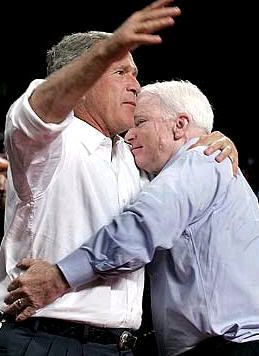
I love you, man!

I love you, man!

Jesus! Be careful, John. Don’t let our genitals touch!

Oh, sorry Mr. President. I guess you only like the legislative hummers you get from me.

That’s right, John. Just like the one you just gave me on the detainee torture “compromise.” You really want to get that Republican nomination for prezinut, don’t you John?

Yeah, I really do.

You always fold like a cheap umbrella, John, but I thought with you being tortured and all, you’d stick to your guns this final time around. Had me goin’ there for a while. Mebbe you are a little funny in the head, jes like we said back when you was runin’ agin’ me in 2000. You sure are a strange fella, John.

I really appreciate the fig leaf you gave me, Mr. President. Lettin’ me say that I haven’t permitted Common Article 3 of the Geneva Conventions to be rewritten. It seemed important to my supporters to be able to say that.

Well of course you haven’t, John, ah will be doin’ that.

Right.

Leggo me, John.


Spotty adds:

As reported in Empire Burlesque, here’s what the Senate majority leader and cat torturer said about the compromise:

Senator Bill Frist of Tennessee, the majority leader, said the agreement had two key points. “Classified information will not be shared with the terrorists” tried before the tribunals, he said. And “the very important program of interrogation continues.”

Here’s what the ACLU said about the compromise, from a Daniel Froomkin column in Friday’s Washington Post:

Caroline Fredrickson, director of the ACLU's Washington office released this statement: "This is a compromise of America's commitment to the rule of law. The proposal would make the core protections of Common Article 3 of the Geneva Conventions irrelevant and unenforceable. It deliberately provides a 'get-out-of-jail-free card' to the administration's top torture officials, and backdates that card nine years. These are tactics expected of repressive regimes, not the American government.

"Also under the proposal, the president would have the authority to declare what is -- and what is not – a grave breach of the War Crimes Act, making the president his own judge and jury. This provision would give him unilateral authority to declare certain torture and abuse legal and sound. In a telling move, during a call with reporters today, National Security Advisor Stephen Hadley would not even answer a question about whether waterboarding would be permitted under the agreement."

When Spot was a pup, Spot’s pop told him a story. In WWII, Spot’s pop was a military policeman, and one of his jobs, especially toward the end of the war, was to search newly-captured POWs and send them to the rear. It is so long ago now, that Spot isn’t really sure whether this happened to Spot’s pop, or whether he had just heard about it. And Pop is not around to ask.

Anyway, the story is that a young German soldier surrenders to the Americans. He’s a kid really, and the war is as good as lost for the Germans. When being searched, the soldier wants to keep his white handkerchief. When asked why, the soldier responds, When I got drafted, my father gave me this handkerchief of his and told me to wave it in front of the first American soldier I saw. And I did.

And that, boys and girls, is what has been lost.

Tags: , ,

Saturday, September 23, 2006

Neiwert's book review

Oy vey, what a week Sigmund Spot has had! It started last Saturday when . . . well, never mind. It was trying, but not all that interesting. That's why it's called a dog's life. Spot is sorry to have neglected you, boys and girls.

MNO loaned Sigmund Spot John Dean's Conservatives without a Conscience a few weeks ago. Some interviews and commentary about the book got Sigmund Spot thinking about the authoritarian personality again, and he was glad to have a chance to read the book.

There has been some good research on authoritarian leaders and followers since Siggy's groundbreaking work with Stanley Milgram many years ago, and John Dean provides a good summary of it.

Although Dean says many trenchant and alarming things, Siggy was left unsatisfied by the conclusions that Dean drew. Siggy figured out why when he read David Neiwert's review of Dean's book on Media Transparency. Spot has pitched Media Transparency before, but it is hands down Spot's favorite investigative journalism site. Hands down. Especially on church and state and other social conservatives' favorite issues.

Most of you probably know David Neiwert. He publishes the blog that has the big black and white fish on it. Please read the whole review, but Neiwert takes issue with Dean, who has a need to be the Republican apologist all the way in his book:
For all this insight, though, we are left with a larger conundrum: Where do we go from here? Conservatives Without Conscience drills so deeply into the personal realm that, by the time we reach the end, it becomes hard to raise our eyes up to see the larger political picture that emerges. Dean briefly touches on this when, late in the book, he describes how his studies of authoritarianism led him to also study fascism.

This step was perfectly logical, since the personal and social pathologies that he finds in the conservative movement also take a political form, and fascism is the consummate right-wing political pathology of the modern era. He describes studying Robert O. Paxton's landmark text, The Anatomy of Fascism, yet at the end he backs away:

Are we on the road to fascism? Clearly we are not on that road yet. But it
would not take much more misguided authoritarian leadership, or
thoughtless following of such leaders, to find ourselves there.

Yet in examining Paxton's book, it is difficult -- especially in
combination with the remarkable weight of the evidence and analysis
that Dean provides -- not to conclude differently. Paxton explains
that, as with personal pathologies, fascism consists not of a single
core belief or trait but of a constellation of them, and that real
fascism emerges when they coalesce. He provides a list of nine "mobilizing passions" that together create this constellation:

  • A sense of overwhelming crisis beyond the reach of any traditional solutions;
  • The primacy of the group, toward which one has duties superior to every
    right, whether universal or individual, and the subordination of the
    individual to it;
  • The belief that one's group is a victim, a sentiment which justifies any action, without legal or moral limits, against the group's enemies, both internal and external;
  • Dread of the group's decline under the corrosive effect of individualistic liberalism, class conflict, and alien influences;
  • The need for closer integration of a purer community, by consent if possible, or by exclusionary violence if necessary;
  • The need for authority by natural leaders (always male), culminating in a
    national chief who alone is capable of incarnating the group's destiny;
  • The superiority of the leader's instincts over abstract and universal reason;
  • The beauty of violence and the efficacy of will, when they are devoted to the group's success;
  • The right of the chosen people to dominate others without restraint from any kind of human or divine law, right being decided by the sole criterion of the group's prowess in a Darwinian struggle.

Conservatives Without Conscience tends to demonstrate, actually, that we are indeed well on the road to fitting that description thoroughly. Dean's hesitation may well be due to the reality that the description does not fit completely (the conservative movement, beyond its war making, is not particularly violent yet, for instance, though violent rhetoric is becoming increasingly popular in its ranks), but it is hard not to see that the differences are dwindling daily.

So that's it, boys and girls. Dean refuses to draw the conclusion that his own evidence presents.

It's a compelling book, and Neiwert's review makes it even more so.

Thursday, September 21, 2006

Absolutely unforgiveable irresponsibility

Spot was thankfully otherwise occupied last evening and this morning. He hasn't had chance to comment on the wounded bellowing of Michael Brodkorb and Pat Shortridge (no links) about a blogger's viewing of an unaired Kennedy campaign TV ad. The blogger passed the link on to a Klobuchar staffer, who got herself fired for viewing the ad, too. Here's a story from the Strib with a good summary of the flap.

Charlie Quimby has an excellent perspective on this, and he faults the advertising agency for not providing security (latter link to Chuck Olsen at New Patriot) for the ad. Spot absolutely agrees.

There is no indication, by password control or warning screen or anything else whereby Kennedy's agency claims trade secret on behalf of itself or Kennedy.

Apparently, the agency's work for a lot more clients than Kennedy is available with nothing more than the client's name.

Boys and girls, this is not how you maintain a trade secret. Proof of reasonable steps to protect the information is a critical element. Clients of this agency have more than a little reason to be alarmed.


Update: There is apparently no user registration or login on the agency site. Unbelievable.