Keith Olbermann summarizes Hillary Clinton's strategy for the Democratic nomination.
A thump of the tail to Buzzflash.
Technorati Tags: Keith Olbermann,Hillary Clinton,Bill Clinton,Democratic nomination,campaign strategy
Keith Olbermann summarizes Hillary Clinton's strategy for the Democratic nomination.
A thump of the tail to Buzzflash.
Patrick Condon of the Associated Press repeats the canard of Doug Tice of the Strib (although Spot can't find the link to the Big Question post at the moment) when he writes that a Minnesota court found that Michael Brodkorb was a journalist:
Brodkorb started Minnesota Democrats Exposed anonymously in 2004, when he was still a paid employee of the state Republican Party. He outed himself in 2006 only after a Democratic public relations consultant sued him for defamation for an item Brodkorb posted. A judge dismissed the lawsuit last year, saying Brodkorb deserved the same legal protections as newspapers and traditional broadcasters against lawsuits by public figures.
Actually, Patrick, he didn't exactly out himself, but never mind that for now.
The implication is that Michael Brodkorb is entitled to some kind of protection as a news source. Condon has it backwards: Brodkorb was sued by a public figure, and because the plaintiff was a public figure, the plaintiff had to show malice to recover for libel. Brodkorb's status really had nothing to do with the outcome.
A careful reading of N.Y. Times v. Sullivan makes it clear that, at its base, it was a free speech case, not a press case. The media are the principal beneficiaries of the decision, but its protections are for everyone: media outlets and ordinary citizens alike, including Michael Brodkorb. But that doesn't put Mikey in a category with "newspapers and traditional broadcasters."
In Times v. Sullivan, the Supreme Court considered the Alabama libel law that permitted a judgment against the Times by a public official to be the equivalent of the Sedition Act of 1798:
That statute made it a crime, punishable by a $5,000 fine and five years in prison,
"if any person shall write, print, utter or publish . . . any false, scandalous and malicious writing or writings against the government of the United States, or either house of the Congress . . . or the President . . . with intent to defame . . . or to bring them, or either of them, into contempt or disrepute; or to excite against them, or either or any of them, the hatred of the good people of the United States."
The Sedition Act, along with the Alien Act, were blots on the presidency of John Adams.
A number of people were convicted under the Sedition Act, and certainly not just newspapers. The act provided for the defense of truth, but often the utterances of the defendants were incorrect in some trivial detail, just as was the case in Times v. Sullivan.
The Sedition Act was allowed to expire - it did have a "sunset" provision in it - and President Thomas Jefferson pardoned every person convicted under it. Congress also voted to return any fines paid.
The Court said that "the court of history" had condemned the Sedition Act for its effect on free speech and the airing of comment on the performance of public officials in particular.
The Supreme Court may have saved Michael Brodkorb's bacon, but it didn't make that poisonous scrub a journalist.
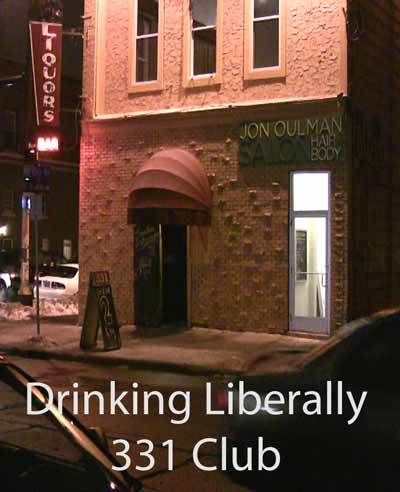 Mark your calendars for Thursday, May 8th for a return visit by Ashwin Madia. Ash is the DFL-endorsed candidate for Congress in the Third Congressional District. He's a terrific speaker that you'll all enjoy hearing. Six to nine at the 331 Club in northeast Minneapolis.
Why is Mr. Madia coming back to DL, Spotty?
Well, grasshopper, Spot invited him to come and take a victory lap and tell us a little about plans for the upcoming campaign against Erik the Bland.
The word is that Chris Truscott, the Media Director for the Madia campaign, may also put in an appearance.
Boys and girls, Spot has been making fun of Andy and his run in with the law over the past few days. But the denouement, at least in Andy's fevered imagination, deserves special mention.
By way of background, Andy's loveable mutt, Lugnut, apparently jumped Andy's fence and picked a fight with the neighbor dog. Andy is offended that he received a citation for a loose dog. And he decided that he needed a better fence, apparently to protect Lugnut and his kennel mates, but it is not altogether clear from what.
Well, good news, boys and girls; the new fence is up:
Mission accomplished! The doggies are now safe and secure.
I’m fracking exhausted! Too bad now I have to deal with a huge pile of hedge brush, spread some dirt, and lay some sod back there.
But the doggies are safe and we have some privacy.
This is truly a relief, Andy! No longer can the occasional yip of the Chihuahua next door provoke the slavering Lugnut into engaging in an act of preventive aggression! We will all sleep so much better now.
Well, okay, Spotty, Andy's being a moron, but how is he a metaphor?
It's pretty obvious, grasshopper. Andy is the aggressor, or at least Lugnut is, and yet Andy believes that he is the aggrieved party and the one in need of protection. This is the work of a genuine sociopath.
Andy's thinking mirrors perfectly the thinking of the Bush administration on foreign policy. We act like thugs, and then moan with self-pity when there is blowback. But we're so good! We only want to help! It is so ungracious of the Iraqi people not to be more grateful for our help! We merely want to help the Iraqis be free to sell us their oil at low prices! How selfless is that?
No only the Iraqis, but the Saudis. And think how much better off the Iranians would be if they could sell us oil cheap, too! It really is astonishing and saddening that so many people misunderstand the United States and its intentions.
Andy, and Dave and Joe will just write this off as another rant by the "blame America first" crowd. Spot would expect nothing less from the vacuous cheerleaders of a morally bankrupt foreign policy.
Until we figure it out, though, and decide that we should treat other countries as colleagues rather than the conquered, we will not know peace.
From the LA Times:
When Wendy Gonaver was offered a job teaching American studies at Cal State Fullerton this academic year, she was pleased to be headed back to the classroom to talk about one of her favorite themes: protecting constitutional freedoms.
But the day before class was scheduled to begin, her appointment as a lecturer abruptly ended over just the kind of issue that might have figured in her course. She lost the job because she did not sign a loyalty oath swearing to "defend" the U.S. and California constitutions "against all enemies, foreign and domestic."
You see, Wendy is a Quaker and a pacifist. Wendy was willing to sign the oath as long as should could append an addendum, stating that she could not take up arms. That wasn't satisfactory to Cal State Fullerton.
 Jack Nelson-Pallmeyer will be on the public television's Almanac tonight (Friday). That's 7 PM on KTCA, channel 2 in the Twin Cities. Check your local listings.
This is Spot's contribution for Law Day.
MNO said it wasn't called Law Day anymore, Spotty.
As far as Spot is concerned, it's still Law Day. Loyalty Day sounds too much like Richard Nixon and Roy Cohn.
When we left the courtroom where Andy Aplikowski is being tried for the crime of having a loose dog, your humble correspondent Spot had been cross examined by Andy. Andy's dog, Lugnut, was then called as a witness by the prosecution; Lugnut testified that he has escaped from the yard a number of times before. Now it is time for Andy's cross.
Andy approaches the witness stand where Lugnut is seated. Lugnut is a large medium-haired rough-coated dog; he is black and white, and brown, and when you get a good look at him, some tan, too. Lugnut is what they call at the pound, charitably, a "mix."
AA: [somewhat menacingly] Hello, Lugnut.
L: [whining] Hellp, Boss. Aren't you supposed to call me "Mr. Lugnut?"
AA: Just wait 'til we get home and see what I call--
J: [banging his gavel] That's enough Mr. Aplikowski! I won't have you badgering witnesses in my courtroom. And your dog is right: it is "Mr. Lugnut" in here.
AA: [rolling his eyes] Okay, okay. Mr. Lugnut, you say that you have escaped the yard several times. But it's a chain link fence; how is that possible?
L: As you know, Boss, the fence is what? A four footer? I can practically see over the fence! It's an easy jump; you know that.
AA: What I know or don't know is hardly an issue here.
P: Objection. Mr. Aplikowski is trying to testify, I think, and he's not under oath. And what he knows or doesn't know is obviously the issue here.
J: [smiling tiredly] I'm afraid he's right, Mr. Aplikowski. If you want to be a witness, you'll have to call yourself as a defense witness, be sworn in, and be subject to cross examination by the prosecutor. For now, confine yourself to asking Mr. Lugnut questions about what he did.
AA: Okay. Mr. Lugnut, haven't I told you not to jump over the fence?
L: You tell me to fetch your slippers, too. How often have I done that? Yeah, you have said, "Lugnut, don't jump over that damn fence."
AA: How often have I told you that?
L: Pretty much every time you have had to haul me back into the yard after I jumped the fence. I'd say often.
AA: Well, never mind that. So you knew that you weren't supposed to jump the fence, but on that fateful Sunday night you did so anyway. Why?
L: Well, Boss, you raised me right, to be a good Republican dog. The neighbor dog that I attacked? He's a really small dog, but I didn't like the cut of his jib. I thought that sometime, maybe sometime, he would come over and piddle on the fence. I wanted to take him out first. It was an act of preventive deterrence.
AA: Who taught you that idea?
L: George Bush.
AA: [sighing] I have no more questions for this witness.
A trial that at times seemed to exist in parallel universes, with accepted law in one dimension and Robert Beale in the other, came back firmly to earth Wednesday.
Ignoring Beale's indignation, religious beliefs and obscure interpretations of the U.S. Constitution and philosophy, a federal jury in Minneapolis took only two hours to find him guilty of all seven counts brought against him for tax evasion, conspiracy and fleeing authorities.
The question for tomorrow evening is: "What would you ask of or say to a delegate at the Republican National Convention?"
Not that you are likely to get within a hundred yards of one, but never mind that.
Alternatively, as Anon I Moose mentions, this is the fifth anniversary of the "Mission Accomplished" speech by George Bush on the aircraft carrier Abraham Lincoln. You could tell Bush for the camera what you think of the speech.
Same time, six to nine, same place, the 331 Club in northeast Minneapolis.
A lot of people aren't gonna like this one, Spotty.
Nevertheless, grasshopper.
From the Topeka Capital-Journal:
A federal judge in Maryland on Thursday ordered liens on the Westboro Baptist Church building and the Phelps-Chartered Law office.
If the case presided over by U.S. District Court Judge Richard D. Bennett is upheld by an appeals court, the church, at 3701 S.W. 12th, and the office building, at 1414 S.W. Topeka Blvd., could be obtained by the court and sold, with the proceeds being applied toward $5 million in damages Bennett imposed on church members for picketing a military funeral.
 You all remember Fred Phelps and his merry band, don't you? The people who brought gay-bashing to a new low by picketing military funerals on the theory - which quite eludes Spot, frankly - that the tolerant attitude toward gays in the United States is getting our soldiers killed in Iraq. Pat Robertson says that gays attract hurricanes, which makes so much more sense. You can read more about the man in the white hat here.
Phelps and his church came to national attention when they picketed the funeral of Matthew Shepard, a gay student at the University of Wyoming who was killed by a couple of homophobes that he met in a bar.
If you read the comments to the Capital-Journal article linked above, you will see that the commenters almost uniformly expressed satisfaction, perhaps even glee, that Phelps & Co. may take it in the shorts. There is certainly a part of Spot that feels that way.
However. Banning hate speech is a dubious proposition, and a dangerous one for the civil libertarian.
The leading case in this area is still Brandenburg v. Ohio, decided by the Supreme Court in 1969. In that case, a unanimous court reversed the conviction of a Ku Klux Klan member who was tried and convicted for saying:
I believe the nigger should be returned to Africa, and the Jew returned to Israel.
But Spotty, that was a criminal case. Here, the father of a dead soldier got a judgment for the intentional inflection of mental distress, no conviction was involved!
Good observation, grasshopper, but the First Amendment will protect the speech either way. Do you remember discussing N.Y. Times v. Sullivan with Spot before?
Isn't that the case where a city official in Alabama sued the New York Times for libel and won a judgment because some of the things in an ad taken out by civil rights groups had some factual errors in them? And the official claimed that it damaged his reputation?
Yes, and?
The Supreme Court ruled unanimously that Alabama libel law unconstitutionally infringed freedom of speech because the prospect of a large award by a Southern jury against a newspaper would chill the newspaper's discussion of the conduct of public officials?
That's right. The Court held that a libel plaintiff, if he was a public official, would have to show that the newspaper acted maliciously. Parenthetically, boys and girls, Times against Sullivan is one of the very important reasons why Martin Luther King's non-violent civil disobedience could be so effective. Northern media could show Southern blacks being attacked with fire hoses, dogs, and clubs without fear of reprisal. The Civil Rights of 1964 and the Voting Right Act of 1965 are part of the legacy of the courageous reporting of the New York Times and Times against Sullivan.
But Spot digresses. What did the Supreme Court do in the Times case?
It placed limits on the reach of state tort law in order to protect free speech.
You are so smart sometimes, grasshopper, that it just takes Spot's breath away. A similar result might be expected here, saving Fred Phelps' unworthy bacon. It certainly isn't clear to Spot that Phelps & Co. were trespassing or otherwise disturbing the peace in the sense of creating an immediate incitement to violence, other than maybe by the counter-protesters, which doesn't really count.
We have to put up with a lot in the name of free speech in this country. In a lot of places, being a Holocaust denier can land you in prison. But we tolerate that, and, so far, we also protect the burning of Old Glory as symbolic protest speech.
What do you think, boys and girls? Should mangy ol' Fred have to disgorge everything because he says stupid and unpopular things?
When we last left Andy Aplikowski, he was bemoaning the fact that he had received a citation for failing to control his dog, a hairy brute of doubtful provenance named "Lugnut."
I happen to have a little to say about this [dog legislation being considered] as Lugnut was a bad boy Sunday night. He got out and got into it with a dog which apparently lives behind me. The people called the City, saying my dog was dangerous, and I was issued a citation for a loose dog. No one was harmed, I’m not so sure what really happened but I’m just going to deal with it.
Andy decides to contest this manifestly unfair action by the jackbooted thugs at Animal Control. He pleads not guilty and represents himself at trial. Your faithful correspondent Spot is called by the prosecution as an expert witness on dog and owner relations. After his direct testimony damning Andy for his neglect, it is Andy's turn to cross examine Spot. We pick up the action there.
AA: Spotty, you say you're a dog, right?
J: That's Mr. Spot in the courtroom, please.
AA: [rolling his eyes] Ok, Mr. Spot, you say you're a dog.
S: No actually, Spot doesn't think he said that; he thought it was apparent.
J: Mr. Spot, will you knock off that third-person reference crap in my courtroom?
S: Oh, of course, Your Honor. Sp --, I'm sorry. And I'll stipulate that I am a dog.
AA: What?
J: It means you don't have to prove that he is a dog. That should lighten the load a little for you.
AA: Mr. Spot, have you even seen the defendant?
S: Well, I'm talking to him right now.
AA: I mean Lugnut.
S: Lugnut is not the defendant; you are.
AA: [rolling his eyes] Ok. Have you ever seen Lugnut?
S: Well I've seen pictures of him; he's a little unkempt I must say. He could use a trip to the groomer.
AA: Objection! Slander!
J: Overruled. I've seen the pictures, too. Lugnut is pretty mangy. In fact that will be one of my findings.
AA: Mr. Spot, if you've never seen Lugnut, how do you presume to judge him?
S: Your Honor, will you remind Mr. Aplikowski that we're - well you're - here to judge him, not Lugnut?
J: He's right, Mr. Aplikowski.
AA: Did you know that kids from the Sunday School at the church that abuts my house like to tease my dogs on Sunday morning?
S: I thought the incident in question took place on a Sunday night.
AA: It did. But don't you think that Lugnut was still worked up Sunday night over events that morning? He is a brooder.
S: I won't speculate about that. But I don't think it makes any difference.
AA: What? You don't think that an encounter with giggling children in the morning wasn't sufficient provocation for Lugnut to jump the fence that night and attack the neighbor dog?
S: As a species, we're not that complicated, Mr. Aplikowski. And the ordinance says no loose dogs, and you had one. Don't try to blame it on the children. The kids probably only teased, to use your word, Lugnut because he acted aggressively when they were around. Spot finds that children are uniformly friendly around Spot: all the petting and hugging can be a bother sometimes, but it's the price of celebrity, I guess.
AA: Well, what am I supposed to do about the kids?
S: One simple thing would be to keep him in the house on Sunday mornings. It's only one morning a week. That would seem like the neighborly thing to do anyway; barking at churchgoers isn't very civilized.
AA: But it's my yard, and Lugnut's, too!
S: Indeed it is. But when Lugnut hurls himself over the fence and picks a fight with his neighbor, that's not in his yard, is it?
AA: Your Honor, do I have to answer that?
J: No. It was sort of a rhetorical question. The point was made without your answer.
AA: This witness is a waste of time. I call myself as a witness.
J: Not yet, Mr. Aplikowski. The prosecution has one more witness. Bailiff, will you bring in Mr. Lugnut from the hallway?
Continuing the salon discussion of what it means to be a citizen and what you'll be doing during the Republican National Convention, Drinking Liberally will meet tonight at its usual place, the 331 Club in northeast Minneapolis. Meeting time is six to nine.
Word now arrives at the doghouse that Fightin' Joe Repya has a blog. He calls it The Eagle's Nest. It's kind of a regrettable name.
Why do you say that, Spot?
Well, grasshopper, here's the real, or at least historical, Eagle's Nest:

Ooh, that is a bad association.
Well, never mind grasshopper; we'll let Joe fight it out on the battlefield of ideas.
Just be sure, Joe, that you never go into a battle of wits lightly armed!
Spot did notice one thing, though. In the posting Joe has done so far, Spot found only one link, to a letter to the editor in the Strib that he was going to criticize. Yet, the posts are full of Iraq cheerleading and references to what Joe undoubtedly likes to call "the facts on the ground."
The Uptake won a City Pages "Best" award this year for the Best Citizen-Based Media Outlet. Congratulations on the award; it is well deserved.
Spotty you won an award last year from City Pages for the Best Liberal Political blog, didn't you?
Why yes, grasshopper, now that you mention it, The Cucking Stool did. There's a little badge on the right-hand column with a link to the award. It's nice of you to remember.
Who won in that category this year, Spotty?
As far as Spot can tell, grasshopper, nobody won in the category. Apparently after The Cucking Stool won last year, the editors saw little point in continuing the competition.
Nick Coleman got the award for Best Columnist which is richly deserved. As the City Pages editors observe, he cut Carol Molnau into bite-sized serving pieces almost too often to count.
Steve Sack, the usually perceptive cartoonist at the Minneapolis Star Tribune, drew this one for the paper today:

Yeah, Spotty, what was that old guy thinking, talking to Hamas and urging it to consider peace with Israel? Boy, the nerve of some people.
Sack was probably picking up on remarks by America's Warrior Princess, Condi Rice:
“We wanted to make sure there would be no confusion and there would be no sense that Hamas was somehow a party to peace negotiations" between Israel and more moderate Palestinians, said Ms. Rice, speaking on the margins of an international meeting here on aid to Iraq.
Making peace is our job, Spotty! We're so good at it!
We are, aren't we, grasshopper? Anyway, Spot will say in Carter's defense that his recollection of the conversation with the State Department about meeting with Hamas went a little differently:
"No one in the State Department or any other department of the U.S. government ever asked him (Carter) to refrain from his recent visit to the Middle East or even suggested that he not meet with Syrian President (Bashar) Assad or leaders of Hamas," said a statement released by the Atlanta-based Carter Center, which speaks on the former president's behalf.
Sadly, the AWP apparently missed a couple of days at diplomacy school when some Very Important Stuff was discussed.
Like what, Spotty?
That you don't get to pick your adversaries, for one thing. You have to deal with the one that's there, not your idealized view of the perfect pushover adversary. Spot wishes he had a nickel for every time Israel, or some blind supporter of it, said, "We don't negotiate with terrorists," or "Arafat is not a partner for peace." He wouldn't have to write this blog.
You don't make any money on this blog, Spot. You don't even accept advertising.
Oh, right. He'd still like the money. But Spot digresses.
Before you go off and make extravagant statements about who you will or will not talk to, you'd better be sure that you're prepared to deal with the consequences of not talking to somebody. If you insist on total surrender, you'd better be able to get it.
We have a pretty good object lesson in this from the war in Iraq. For a long time, the administration's position was that we were just going to whip the Sunni insurgency. When it became clear that strategy wasn't going to work, somebody got the bright idea of co-opting some of the insurgency to our side, and the Sunni Awakening was born. We talked to the enemy. We now find ourselves in the awkward position of funding and arming Sunni militias that are not part of the government in Iraq, but the principle is still illustrative.
Grasshopper, what do you think the likelihood is that Hamas can be stamped out?
Well, since Hamas is the popularly-elected government of the Palestinians, and since it's a guerilla movement, probably not very great.
Right, grasshopper. Better to talk to Hamas. Which brings Spot to his second point.
In the terrorism department, the Palestinians have learned from some of the best.
More than 2,000 years ago the first known acts of what we now call terrorism were perpetrated by a radical offshoot of the Zealots, a Jewish sect active in Judea during the 1st century ad. The Zealots resisted the Roman Empire's rule of what is today Israel through a determined campaign primarily involving assassination. Zealot fighters used the sica, a primitive dagger, to attack their enemies in broad daylight, often in crowded market places or on feast days—essentially wherever there were people to witness the violence. Thus, like modern terrorists, the Zealots intended their actions to communicate a message to a wider target audience: in this instance, the Roman occupation forces and any Jews who sympathized or collaborated with the invaders.
July 2, 1946: The King David Hotel in Jerusalem was bombed, killing 91 people
Menachem Begin, who was later awarded the Nobel Prize for peace, is the same man who planned the destruction of the King David Hotel and the massacre of Deir Yassin. Ex prime minister, Shamir, was originally a member of the Jewish terrorist gang called Irgun, which was headed by none other than Menachem Begin. Shamir later moved over to the even more radical "Stern Gang," which committed many vicious atrocities. Shamir himself has defended the various assassinations committed by the Irgun and Stern gangs on the grounds that "it was the only way we could operate, because we were so small. So it was more efficient and more moral to go for selected targets." The selected moral targets in those early days of the founding of the state of Israel included bombing of the King David Hotel and the massacre of Deir Yassin. [italics are Spot's] April 9, 1948 A combined force of Irgun and Stern Gangs committed a brutal massacre of 260 Arab residents of the village of Deir Yassin. Most of whom were women and children. The Israeli hordes even attacked the dead to satisfy their bestial tendencies. In April, 1954, during Holy Week, and on the eve of Easter, The Christian cemeteries in Haifa were invaded, crosses broken down and trampled under the feet of these miscreants, and the tombs desecrated. The Israeli military conquest, therefore was made against a defenseless people, who had been softened up by such earlier massacres as Deir Yasin (where 250 Arabs; men, women and children were massacred).
When "terrorism" is committed by the weak and dispossessed against their oppressors, and it's by a guerilla movement with popular support, it is virtually impossible to stamp out. History is littered with examples of this. The AWP must have missed that day, too.


 Marmots are, in fact,