Posted to You Tube by the Unclassified Producer.
Update: A thump of the tail to Ag for the link.
Spot does not intend to write about Katie's column today; Spot would rather strip woodwork at the doghouse. However, the Wege has measured up today's offering, and finds it sadly—although not unexpectedly—lacking. Go read what Wege has to say; here's the lede:
Give Katherine Kersten some credit: at least she waited until the last of the bodies had been recovered before assigning blame for the bridge collapse.
In the wake of the Interstate 35W bridge collapse, DFL leaders want to raise the state gas tax to fund transportation needs.
Starting out with a lie is a pretty rotten opening. This paragraph is a lie because Kersten's first four words are "[i]n the wake of," implying a response when in fact DFL leaders have tried to raise the state gas tax in consecutive legislative sessions. Raising the gas tax is a continuation of existing DFL policy. Repairing infrastructure is a core Democratic issue. Kersten would have you think that the DFL is responding to the collapse when in fact they generically anticipated it and worked to avoid such a tragedy.
Spot will only add that Katie is funny when that defensive tone creeps in.
Have you read Spot's last post Do you see a pattern here? If you haven't, it is important that you do before you read the paragraphs that follow in Voltaire's Bastards:
The point of these well-known examples is that, whatever the merits of each case, modern structure responds to its own errors by a refusal to admit error. It responds to failure by a denial of failure. The system could prove that it does work by simply responding to problems with an open mind, rapidly and positively, eager to find solutions. Instead it automatically goes into a defensive pose, throws out diversions intended to slow criticism, then spends time and money to prove factually that there is no problem. As a final ploy it will attempt to gain time for new ploys by agreeing to negotiate. If even this fails, the system will drop its own position, grasp that of the other side and treat the new position as if it were an absolute truth always known.
The explanation for such odd reactions to rather straightforward problems is that systems are constructed from an assumption of correctness. They are built backwards from this assumption. There is no room for error, except through some properly laid-out procedure: That is why the system is unable to simply assimilate all the obvious factors before coming to conclusions.
Thus acid rain may lead to the destruction of trees but it doesn't fall into the same process as the decline of the Rust Belt states. And leaded gasoline may harm agriculture and stone buildings, but it doesn't fall into the same process as trade balances or competition regulations. The officials in charge of all these procedures are decent people. It's just that there is no room for them to use their common sense. And from the structure's point of view, when there is an error, it is the error which is in the wrong.
This is why the tyranny of the technocrats—and the economists who love them—can be so seriously, obviously, and tragically (in the Greek drama sense) wrong. And you see it around you all the time, boys and girls. Just as a recent example, in an op-ed piece in the Strib discussing policy options after the bridge collapse, Sean Kershaw and Bob Deboer of the Citizens League, technocrats and good government types to their core, say this:
Minnesotans love local control, and in the case of transportation projects, the term is "municipal consent." When the state wants to replace a bridge, it must negotiate and receive consent from the cities involved. Closing roads costs a lot of money, so it might be prudent to do other associated projects, but when local concerns and demands go beyond replacing the most needed infrastructure, does that slow us in getting to our next priorities?
Of course, if it wasn't for municipal consent, this is the bridge we certainly would have gotten. It would be more efficient, a word these boys really love, in the sense of getting rid of some of those pesky democratic voices. Who do those people in Minneapolis think they are anyway? The bridge is only going to be in their city! Shut them up!
It is perhaps obvious that Spot thinks that Sean and Bob are full of something, and it isn't good ideas.
There was a letter in this morning's Strib from a Bloomington resident—one of those pesky local voices—who took issue with Sean and Bob, too:
In their Aug. 16 commentary, Sean Kershaw and Bob DeBoer of the Citizens League question the value of the current "municipal consent" process whereby local governments exercise oversight over freeway designs.
Eliminating the municipal consent process might save the Minnesota Department of Transportation money; however, any savings would come because MnDOT engineers would no longer be compelled to consider noise impacts on local residents, the effective coordination of transportation and land-use planning, or, as we've seen in the past week, the incorporation of transit facilities into their designs.
MnDOT's engineers do a fine job of optimizing their designs to best serve the "convenience and safety of the motoring public," but they tend to define their jobs rather too narrowly to guarantee that the interests of the public at large will be well served without oversight.
STEVE ELKINS, BLOOMINGTON
Mr. Elkins also recognizes that the blinkered technocrats at MnDOT are not going to consider all of the things that ought to go into transportation decisions.
It came as a shock to many people the number of bridges in Minnesota and around the country that are in such dismal shape. Why was it such a surprise? Partly because of a lack of transparency in government and partly because of a lack of media attention. The system that exists in Minnesota and the US, whereby citizens can make a request for information before it is revealed, means that the information remains locked up unless somebody thinks to ask for it. This means we need an aggressive investigative reporter on every government beat every day. And we know how likely that is to happen in the present newspaper environment. Secrecy is convenient to whatever administration is in charge. It obviously makes policies easier to sell.
Spot has a not-so-modest suggestion. All proceedings of government, and all information kept by the government, except perhaps in the case of individual citizen files, be published on the 'net. Real "national security" secrets would also be exempt from disclosure, but some mechanism would have to be established to insure the secrets were really related to national security, and not just embarrassing for the administration. Like "interrogation" methods.
The alternative is the continued choking off of the democratic process and our "management" by the technocrats and the tyranny of experts.
[update] The line identifying Mr. Elkins as a Bloomington City Council member was not copied from the newspaper. [/update]
A little more from John Ralston Saul's Voltaire's Bastards, written in 1992:
The massive destruction of forests by acid rain, and the crumbling of European cities because of leaded gasoline are two very simple examples [of the systemic lack of common sense]. The solutions are practical and imaginable and have been for a long time. Instead the American government has persisted for years in asserting that there is no solid proof of a link between acid rain and the death of forests. The United States has glanced away from their own New England states and Canada towards the Midwestern industrial states, which said that smokestack modernization would bankrupt them. And so a five-year study was proposed to look into the matter. When popular pressure in the late 1980s — which the authorities identified as irrational panic — reached a dangerous level, the government offered a series of half measures. These were proposed not as part of an admission that the problem existed but as a political sop. The basic denial continued.
For years the authorities and the experts in Britain and France fought desperately against unleaded gasoline. They did everything they could to discredit the environmentalists — calling them ignorant, childishly emotional and subversive. When, in the late 1980s, it was no longer possible to go on ignoring the problems of lead pollution, the two governments set about arguing over the level of response necessary. This process lasted a year. At the EEC level, many of the members were worried about the increase in oil import costs that lead-free gasoline would involve. Their economists told them this would have an important impact on their balance of payments. In the end all the governments compromised in favour of a gradual lead-reduction program, which will cost each country thousands of times more in damage to buildings and health than it will in oil imports. [italics are Spot's]
The destruction of buildings, damage to statuary and long-term illness, however, are not part of the annual balance of payments. In order to maintain the fiction that their compromise is the correct one, the majority of EEC governments have been ready to prosecute member governments, such as the Dutch, who are unwilling to wait for clean gas. The Dutch said their cities and countryside were dying. The EEC replied that the strong Dutch environmental control regulations constituted unfair competition barriers to the other community members. The very idea that environmentally sound regulations could constitute unfair trade barriers to environmentally unsound products is an indication of the Alice in Wonderland mentality among Western elites.
If this doesn't remind you, boys and girls, of the global warming "debate," you aren't paying attention. We are told that efforts to try to mitigate global warming will be just too costly. Costly compared to what? The loss of valuable real estate due to rising sea levels? Damage from an increasing number of Category 5 hurricanes? Once fertile land becoming too arid to till? Public health issues of which we yet have no inkling, but almost certainly exist?
This is why the economists' beloved cost-benefit analysis is often so useless. There are social costs and externalities of unknown and untold magnitude for most government policies, initiatives, or regulations or lack of them. Pretending to model the economic effects of global warming is just that: pretending. Basing policy on the conclusions of the "expert modelers" is worse than pretending.
It is time to take policy making back from the experts, the confidence men, and the outright knaves who reassure us with their blarney while stealing the public interest. An excellent place to start is with the fumbling stewards of our public infrastructure and their apologists.
Standing astride I-94, with a bicycle clenched in each raised fist, the Colossus of St. Cloud roars:
Local DFL leaders are still drinking the ethanol.
Calling today’s investment in ethanol production “feedstock,” U.S. Rep. Collin Peterson believes the nation can reach energy independence in 10 to 15 years.“The bottom-line goal is for us to get off foreign oil,” Peterson, DFL-7th District, said Friday at an energy conference at Bemidji State University.
He was joined by U.S. Rep. Jim Oberstar, DFL-8th District, who said in his remarks that moving more Americans to public transit — or bicycling — can negate the need to import millions of barrels of foreign oil.
(Yes, I know, I laughed at the bicycle reference too!)
Spotty, maybe if the perfesser got off his lard arse once in a while, he would know that Minneapolis is second only to Portland, Oregon in bicycle commuters:
According to U.S. Census Bureau statistics released this month on the 50 cities with the most workers, Minneapolis has the second highest percentage of people who bike to work. The bureau said 2.4 percent of Minneapolis’ 189,294 workers (16 and older) pedal to their jobs, which is second only to Portland, Ore. and several times higher than the national average of 0.4 percent.
Grasshopper, I think that is the first link you have ever brought in. Congratulations! But that was not a very charitable thing to say about the professor. We expect a little more decorum around here.
Sorry, Spotty.
We need not speak of it again. It is true that bicycles do play an increasingly important role in commuting transportation.
The gravamen of the professor's post is that ethanol and biodiesel fuel production has decreased the need for government price supports for small-grain agriculture, but that we won't see the savings in tax cuts. Of course not professor, we have things like this to pay for:
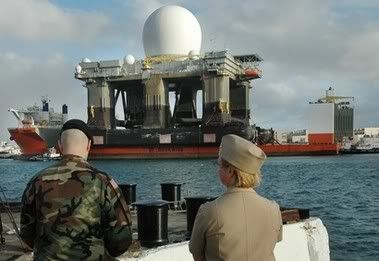
Military personnel watch as the Sea-Based X-Band Radar sails into Pearl Harbor, Hawaii , aboard the MV Blue Marlin, Monday, Jan. 9, 2006. The 280-foot tall Sea-Based X-band Radar is so powerful it can identify baseball-sized objects from thousands of miles away. (AP Photo/Ronen Zilberman)
According to Time Magazine:
Since President Ronald Reagan initiated his Star Wars program, about $100 billion has been spent on U.S. missile defense.
If this thing works, we'll be able to tell when Kim Jong-il unzips his fly! No word yet on whether it can find cracks in interstate bridges.
Charlie has a good post pointing out that "Chad the Elder" waxed orgasmic about what he thought was a private toll road in Colorado, when of course, it's not. Just as good, maybe better from Spot's perspective, is that King Banaian took up the baton and ran with it:
While some seem to think a public discussion of spending priorities is a good idea, I think it would be at best a waste of time to contemplate where government's inability to rationally allocate resources and form capital would do the least harm, when private alternatives are present and proven.
Perhaps, Professor, you ought to consider a fact checker for Elder's work! You will recall, boys and girls, that "private bridges" is the same mantra that our nebbish Hamlet recommended on Sunday. At the end of Spot's post just linked, he promised to tell you about the construction of the Paris sewer system.
What could that possibly have to do with private toll roads and bridges, Spotty?
It has a lot to do with them, grasshopper. The key is the identification of the public interest. This story is about the Paris sewer system, but it probably applies to a lot of eighteenth and nineteenth century urban areas. Spot doesn't have a particularly good link for you, boys and girls; it seems most of the scholarly articles are tied up in proprietary databases. It is apparently Bonaparte who got things really rolling in starting to deal with what was an increasing public health concern, namely the pouring of raw sewage into the Seine. Even so, it was decades before anything approaching a comprehensive sewer system was in place.
The decision to construct a comprehensive sewer system was driven by the private market, wasn't it Spotty?
No, grasshopper, the "public" and especially the property owners (the landlords of the increasingly dense residential tenements) who would have to pay for the system preferred the private solution: continuing to throw excrement into the streets where it would run into the Seine. These were the right wingers of their time, and they had to have a sewer system shoved down their throats by Bonaparte, successor governments, and the French civil service. Why? Because the free market could not identify and coalesce around the public interest.
The idea that you can get public goods like clean water, or a safe transportation system, through private decision-making is a notion so loony that someday students will laugh when told about it in class. The purpose of a private market is to adjust and maximize individual interests, and there is nothing at all wrong with that. It is just the wrong tool for figuring out what's good for everybody. Sure, it seemed to the landlords better and cheaper to have their tenants throw their doo-doo in the streets, but when you got a cholera outbreak, it was hard on rent collections.
One thing that actors in private markets always do is try to avoid paying all the externalities of their conduct; that's the way to maximize profit. Social costs are externalities: public health and safety, for example. If safety is left to private hands, you get the Ford Pinto.
A trailer for an upcoming film:
Posted Jul 28, 2007
"People weren't the only ones who lost friends on 9/11."
A thump of the tail to Avidor for the link.
Did you hear the music that was playing when you opened your newspaper this morning, boys and girls?
Yeah, Spotty, what was that about? It was Wagner, wasn't it?
Yes grasshopper, It's the Entrance of the gods into Valhalla from, Spot thinks, Das Rheingold.
Tell us what it means!
It means of course that Katherine Kersten is back in town. She asked Tice to include the music chip in the paper. Katie's been gone, really, since the bridge collapse, and this was her first chance to "weigh in" on it as she says in Bridge collapse ought to unite us, not divide us. Here's the lede:
The Interstate 35W bridge over the Mississippi collapsed just before I left the country for 10 days. I hated leaving in the midst of one of our state's greatest disasters. Journalism, after all, is about instantly weighing in on important matters.
One can imagine Katie's angst at having to leave in the midst of it all:
Katie: Oh Mr. Tice! I'm sorry, but I have to go on vacation! Our tickets to Frankfurt are not refundable. I also have tickets for the birthplace of Pope Benedict and his attached Hitler Jugend memorabilia collection in Bavaria. Then there's our week's reservation at the cute little bed and breakfast in Berchtesgaden. I really have to go.
Tice: [thinking to himself: what's she really going to contribute, anyway?] All right, Katie, but you owe me.
Katie: Oh thank you Mr. Tice. You won't regret it!
Tice: [muttering] You're right; I'm sure I won't regret it.
The column that Katie produced for today was probably penned on the plane ride home. She certainly didn't have to be in Minneapolis, or anywhere else on planet earth, to write it. It's the work of a propagandist, not a journalist.
More than that, Spot will not say. He does commend to you the Wege's pithy remarks about Katie's column at Norwegianity.
[update] New kid on the block Suddenly South also observes the tag-team effort of Mitch Pearlstein and Katie on the same subject on consecutive days. Both spawn of the Center of the American Experiment. [/update]
Alternate title: Mitch in tights
The curtain rises, and a short, chubby man walks toward the circle of light on the stage cast by the spotlight. He is wearing black tights—that apparently constrict his stride, for he is shuffling—a too-tight black tunic with puffy sleeves, and an absurd triangular velvet hat with an ostrich plume. The man arrives in the circle; he looks up at the spotlight and is instantly blinded; he ducks his head quickly and rubs his watering eyes for several seconds. Then, still crying, he slowly raises his head, this time shielding his eyes by making a visor with his hands. He clears his throat and begins:
To raise taxes, or not to raise taxes,
That is the question!Whether 'tis nobler to suffer the crumbling Bridge,
Or to fix it?Aye, there's the rub!
To take up arms against the gas tax,
Or to swallow it?And end the thousand shocks
That we are heir to.To drive, perhaps to pitch,
Headlong into the abyss
And then to sleep.For some, well, a consummation that's not so bad!
Who is our Prince of Denmark? It's Mitch Pearlstein, the dead center of the Center of the American Experiment, writing in today's opinion section of the Star Tribune. Poor Mitch writes as though he was deciding whether to kill his step-father, not whether to raise the gas tax a nickel or a dime. You take yourself way too seriously Mitch. We don't, so lighten up. It's too bad you and yours couldn't summon up as much gravity in deciding whether to invade Iraq. Here's the lede from Mitch's soliloquy:
Several critics over the last two weeks have made the case for at least a dotted-line connection between the terrible collapse of the Interstate 35W bridge and the determination of Gov. Tim Pawlenty and his allies not to raise state taxes over the last five years. But for any connection to hold, at least one of the following conditions would have to be true, when not a single one is.
It would have to be demonstrated, for instance, that decisions by the Minnesota Department of Transportation about what to do about the bridge -- whether to repair it, how to repair it, when to repair it -- were made on the basis of what such steps might cost. But I know of no evidence that money played any role in determining what state officials or anyone else did or didn't do in maintaining the bridge.
Likewise, to draw any suspect connection between the collapse and the consistent preference of large numbers of Minnesotans to hold the line on taxes, one would have to assume that inspectors and other officials charged with protecting and serving allowed anything other than their professionalism to determine how they gauged the sturdiness and fragility of the state's infrastructure. Without a morsel of evidence that any of them compromised their integrity, it's slanderous to imply that any of them did.
You know Mitch, sometimes karma just comes up and whacks you upside the head. This is from a story in today's Strib, the very same issue that printed Mitch's soliloquy:
Internal MnDOT documents reviewed by the Star Tribune reveal that last year bridge officials talked openly about the possibility of the bridge collapsing -- and worried that it might have to be condemned.
The documents provide the first look inside MnDOT's decision-making process as engineers weighed benefits and risks, wrestling with options to prevent what they believed was a remote but real possibility of the eight-lane freeway bridge failing.
Their concerns were not generalized, documents show. [In other words, they had some areas they were especially concerned about.] The San Francisco-based consultant, URS Inc., identified 52 crucial steel box beams deemed most susceptible to cracking. URS also had a specific recommendation that 24 of the 52 members be reinforced while the remainder would be kept on a special watch. Video of the Aug. 1 collapse being examined by the National Transportation Safety Board shows the bridge first falling on the south end over its shoreline pier -- a section of the superstructure where eight suspect beams were specifically tagged for reinforcing.
'Investment strategy'
Dorgan and senior engineer Gary Peterson denied in interviews that money was a factor in deciding what to do with the Interstate 35W bridge, which was not due for replacement until 2022. They provided a written timeline showing that MnDOT supervisors on Nov. 1, 2006, funded the reinforcing project for $1.5 million, with work to begin in January 2008.
But at least three internal documents suggest that money was a consideration.
The premise of our nebbish Hamlet's argument has just suffered a fatal blow, but let's see what else he has to say, just for fun, eh, boys and girls? This is really what our Prince wants to get at:
For example, Robert Poole of the California-based Reason Foundation has written about how Texas, Virginia and other "fast-growing states" have demonstrated the efficacy of private companies competing for long-term contracts to "design, finance, build, operate, and maintain major highways and bridges." In return, they recoup their investments by charging tolls.
I'm convinced that if done properly, such public-private partnerships would work terrifically. But I also realize how the very notion of privately owned roads and bridges, not to mention tolls, is anathema to enormous numbers of voting citizens. Similarly, and as teased, I recognize how getting Congress to constrain itself is problematic (though it does seem to be making progress on earmarks). And it's clear that while subtracting a quarter of billion dollars from other Minnesota constituencies may not be the hardest political job in the world, it may be close.
Which leaves us where? While those who are intent on raising taxes would face a rough road, and properly so, their opponents -- surprisingly, perhaps, and to my regret -- may find themselves on a no less hazardous one politically. But if ever there was a time to rethink priorities, try new methods, stay within our means and change political equations, how can it be other than now?
This is known, boys and girls, as trying to make lemonade when all you've got is lemons. King Banaian has been furiously squeezing the lemons, too, about which Spot will have more to say later.
Our Prince's argument is essentially, echoing the Grover Norquist theme nationally: Republicans are incompetent at governing, therefore, we should abolish government. Excuse me? Excuse Spot? (Almost fell out of the Bob Dole Speak there!)
Spot has a three word response, which he will explain later: Paris Sewer System.
[update] MNO did a nice job of comparing our Prince to the news, here. Spot also wanted to mention that despite all the floggings in the newsroom by Avista Capital and Par Ridder, Spot thinks the Strib has done a good job of getting to the bottom of the bridge collapse. [/update]
This is beneath you, Spotty.
Even so, grasshopper. Here's a comment to MNO's post Guilty:
These fundamentalists have no disregard for life. They are animals, and deserve no mercy from us. I think letting them go through our court process is too good for them.
Sick of it
Well, Sick, you need to be more careful with the big words! But let's assume for a moment that our cerebral friend meant "no regard for life." Spot says, boys and girls, doesn't that make more sense, given the rest of Sick's comment? Spot thinks so. Anyway.
The first step, boys and girls, in justifying whatever atrocities or mistreatment of your enemies that occur, is to reduce their status to subhuman—or animal, even better. You see, if they're less than human, they aren't even entitled to Common Article 3 of the Geneva Conventions treatment! It is just too bad that John Yoo didn't think of that!
Our enemies never have Any Regard for Life. It is remarkable that it's a trait that runs through everyone we oppose. Do you suppose, boys and girls, that our enemies say the same thing about us?
Boys and girls, ol' Spot reached into the job jar the other day, and boy, did he come up a big loser! The job was strip all the woodwork in the living room of the dog house, including the crown molding, the chair rail, the baseboards, windows, doorway arches, and one entire wall that consists of floor-to-ceiling bookshelves. This stuff hasn't seen the light of day since Spot's boy FDR was president. Spot'll be slaving over a hot heat gun for weeks.
It's almost enough to make Spot wish he was a Republican senator from Alaska.
Spot doesn't think he's ever been called a traitor before; he's pretty sure that MNO hasn't either. But in comments to MNO's post about the Padilla verdict, that's what Swiftee and some of the blog chihuahuas (term on loan from Charlie) he sent over have said. Perhaps you can hear them yapping even now if you listen for it, boys and girls.
Spot will let MNO speak for herself, but as for himself, Spot embraces the term when leveled by the cretinous, spittle-flecked Swiftee and the yobs who agree with him. Spot is a traitor to what Swiftee calls "his country." Maybe not so much traitor as enemy, because Spot has never been a citizen of the country of Swiftee's mind: the ignorant, the bigoted, the intolerant, the completely selfish, the deeply frightened and paranoid, the torch and pitchfork crowd; the country inhabited by persons who believe in salvation by adherence to the formulaic brand of Christianity preached by sweaty demagogues and snake handlers. A country of denizens devoid of both ethical decision-making systems and the mental capacity to use them; dwellers in a land where genuine historical memory—unlike the fifth grader's story book version—is erased.
In other words, a land where civilization can only be found in archeology.
If a dog had been treated as Padilla was, Swiftee and the blog chihuahuas would be in full cry, denouncing the perpetrators.
We may count ourselves as lucky, boys and girls, at least thus far, that the Swiftee nation lives only in Swiftee's fevered imagination. It is astonishing, however, that we have traveled the road of totalitarianism far enough that Swiftee can express his moral vacancy without shame.
Has gone silent, but just for the moment. Spot has it on good authority that it's merely a problem down on the server farm.
Spot recently got this nifty new screen capture program, so he might as well use it:

Hat tip to MNpublius, Minnesota Campaign Report, and Norwegianity. Headline courtesy of Borat.
Here is is, boys and girls. Ain't it a beauty?

Pepsodent, Molnau, and the Republicans are so hell bent on getting something up to cover their embarrassment at RNC convention time next year that no telling what they'll try to shove down our throats. Luckily, the City of Minneapolis does have some say in the matter:
Eager to send a message of unity and cooperation, the Minneapolis City Council moved today toward adopting a statement of principles for rebuilding the Interstate 35W bridge across the Mississippi River.
Minneapolis Mayor R.T. Rybak said the city wants to move "quickly to make sure we speak with one voice."
The council appears likely to easily endorse at its meeting Friday morning the broad set of principles that encourages the replacement bridge be designed and built to meet current and future transportation needs. The second principle said the bridge should be designed to improve vehicle capacity and provide transit capacity.
The bridge design should also incorporate, and certainly not preclude options for future transit improvements, including light rail and bus rapid transit. The bridge should also be built to meet all current environmental standards.
The city's role in rebuilding could be pivotal because, under state law, Minneapolis will be asked to provide what is called municipal consent for the bridge layout as submitted by the Minnesota Department of Transportation. The city could confer consent quickly, move slowly or withhold consent, which could dramatically slow the project that the state [meaning the Pepsodent administration] is aggressively trying to complete by the end of 2008.
One City Council member, Diane Hofstede, actually thinks that aesthetics should be a concern:
Council Member Diane Hofstede, whose northeast ward includes neighborhoods near the bridge, said she remains concerned about aesthetics for the gateway bridge as well as a memorial to those who died and were injured. She also said she [is] to push for pedestrian and bike options on the new span.
Spotty thinks you're on the right track on that first one, Diane, but he's not so sure about the second. Maybe.
Anyway, all this stuff needs to be thought about.
Well, actually it was yesterday! Do you remember, boys and girls, when Spotty said this about the Iraq surge:
There are many other instances of a tyranny of experts, of course. One of the others on prominent display is the "surge" in Iraq. Although President Bush is not tyrannized by the experts—the generals—he wants you to be, boys and girls. If we just entrust the decision to the experts, we won't have to worry about all the death and mayhem in Iraq and the ruin it has made of US foreign policy and our national honor, or accept any responsible for it. By appearing to make a third party the "Decider," Bush also deflects blame from himself.
Gump Worsley (Spot isn't sure that's his real name, boys and girls) at Suddenly South reports this today:
From the LA Times:
Despite Bush's repeated statements that the report will reflect evaluations by Petraeus and Ryan Crocker, the U.S. ambassador to Iraq, administration officials said it would actually be written by the White House, with inputs from officials throughout the government.
And though Petraeus and Crocker will present their recommendations on Capitol Hill, legislation passed by Congress leaves it to the president to decide how to interpret the report's data.
Bush is using the tyranny of experts on you, but not himself, boys and girls.
When Spot put up the first post on this theme, he didn't expect to be offering a fallen bridge as an example of the technocratic thinking, the non-humanist "expert" logic, that blind rationalist calculation that sweeps common sense so easily aside; the bridge hadn't fallen yet. But since it fell, Spot has had the chance to observe the rationalizations for why, or as John Gunyou would say, the perfection of the non-apology.
The very best rationalization is obviously the economic one. When Molnau or Pepsodent say, "We didn't screw up; the bridge had been inspected and everything was fine," there was always the risk that contrary facts would come to light—as they have—and reveal them for the fumbling dunces they are. Much better to go with King Banaian's first instinct: the black swan flying across the sky. Or Bob Huge's sorrowful conclusion that the problem was in the stars.
Because we are so reasonable, so rational, so well, mathematical, even if a bridge falls, how could that be a screw up? By not having the common sense that God gave a goose, that's how.
When economics moved from philosophy to statistics, it lost its humanity, at least in the hands of some practitioners. Practitioners who are like the staff general, oblivious himself to the real conditions or consequences of his order, who sends his army to be mauled because the maneuver looked so rational on the map at HQ. You've all seen that in the movies, haven't you, boys and girls? It's always accompanied by dramatic and ominous music; the director is telling you that somebody is screwing up big time!
When someone in the economics department lectures about the cost benefit analysis and how the value of human life is merely another variable to be considered, the history and the philosophy departments should be piping in the ominous music.
As a "science," the discipline of economics is no more moral than, say, chemistry. Modern economics has been cut loose from its philosophic foundation, and as a simple expert system it cannot make moral and ethical judgments better than the butcher, the baker, or the candlestick maker. If we cede those judgments to economists, we are liable to be manipulated.
There are many other instances of a tyranny of experts, of course. One of the others on prominent display is the "surge" in Iraq. Although President Bush is not tyrannized by the experts—the generals—he wants you to be, boys and girls. If we just entrust the decision to the experts, we won't have to worry about all the death and mayhem in Iraq and the ruin it has made of US foreign policy and our national honor, or accept any responsible for it. By appearing to make a third party the "Decider," Bush also deflects blame from himself.
But there are no moral dodges, boys and girls. We can't leave it to the experts, or the politicians, or even the clergy. It is up to us to make our own moral and ethical judgments and be responsible for the consequences, including our silence.

