Tuesday, February 15, 2011

Political belief lightly gripped

It’s not hypocrisy if you need the money

I read a Hot Dish politics post yesterday noting that Tom Emmer hired on as a lobbyist to, um, lobby for a measure that he adamantly opposed when it came up in the Legislature two years ago. MNO mentioned it earlier today, too.

The issue is the expansion of free-standing, i.e., separate from hospitals, cancer centers. Emmer was for it before he was agin’ it.

Emmer then:

In a spirited debate, the Republican from Delano called the ban “patently unfair” and “micromanaging in its worst form.” He pleaded with lawmakers to let “market forces return.”

Here’s Emmer’s new money shot:

“I am in favor of the free market, absolutely,” Emmer said Monday. “But on this issue, you need to be more considerate.”

Really, that’s what he said.

Emmer continued:

He said if the state were to rip open the marketplace now, “it could be very dangerous … I don’t want to destroy what we have.”

Emmer now believes that market forces can sometimes be destructive, and the destruction isn’t always creative, as some conservatives like to call it. If this is an epiphany for Tom Emmer, I applaud it. But somehow, I doubt it.

This put me in mind of one of the other jersey changers since the election: Pat Anderson, who ran a dismal campaign for State Auditor, despite being backed by the rhetorical firepower of Craig Westover. Here’s Anderson, within weeks of the election, again from Hot Dish Politics:

"During the campaign I was asked by a group of lobbyists what I thought of lobbyists.  I replied somewhat factiously "The problem with lobbyists is they exist."  I still believe that. [if you still believe it, Pat, you didn’t say it facetiously]  But the problem isn't with lobbyists themselves; the problem is that our current "big-government" system creates the need for them," she wrote.

But what is really impressive here is the word salad that Emmer and Anderson each create to claim that their new gig isn’t inconsistent with previously held, and fervently avowed, public positions.

Where is T.S. Eliot now that we need him? Extra credit for the first person who explains why and provides a link.

Not the Onion


Today, in political news so strange you have to wonder if it really might be from The Onion:

The South Dakota House of Representatives recently passed out of committee a law making the murder of abortion providers justifiable homicide.

In Iowa, Republican State Senator Mark Chelgren compared preschool to Nazi indoctrination.

Congressional Republicans (and a few Democrats) seek to decrease the number of abortions by eliminating funding the largest supplier of birth control in the country, based almost entirely on a short video everyone knows is doctored.

Defeated Candidate for Governor Tom Emmer is back at the capitol as a paid lobbyist to push for the adoption of a proposal he once called "patently unfair" and "micromanaging in its worst form."

It must be difficult to write comedy these days.

Update: Oops -- missed one. That same South Dakota legislative brain trust also recently reaffirmed their strong stance against "spouse stealing."

Sunday, February 13, 2011

Dead on Arrival

Mark Dayton’s budget, to be announced on Tuesday, is dead on arrival at the Legislature. At least that will be the message at the GOP press conference responding to his proposal.

Here’s a message you won’t hear but is also true: the all-cuts budget the GOP would like to propose is similarly DOA if it lands on the Governor’s desk. The real question is how much each side will bend to create a budget compromise, and how public opinion will shape an eventual compromise. Tuesday’s posturing will eventually give way to hard reality: Dayton and Legislature need to work with each other.

Dayton’s budget will include cuts and new revenue. While the drafting of this budget has occurred in pretty remarkable secrecy, there have been a few hints. It will include a temporary increase on the wealthiest Minnesotans. It will include a small increase in education spending, but will probably not repay the $1.9 billion shift in one biennium. It will include cuts that will go well beyond the $900 million GOP proposal he vetoed last week. And it will include a few surprises, perhaps one of the reform proposals offered by MAPE, the Association of Minnesota Counties, or health care providers.

How the GOP will respond is equally shrouded in mystery, but again we know a few things. Republicans will not propose a budget that exceeds projected revenues of $32 billion. The Republican leadership has put themselves into a tighter rhetorical straightjacket than a “no new taxes” pledge. While Pawlenty wriggled out of a tight corner by declaring increased tobacco taxes a “health impact fee,” there’s no rhetorical flexibility in the GOP position.

The Republicans might choose to respond to Dayton’s budget with a fully formed proposal of their own, then move their budget through the committee process with those targets. They aren’t required to do so. In 2008 the DFL-led legislature never proposed an alternative budget. The GOP leadership could continue their piecemeal budgeting approach by taking cuts proposed by Dayton and sending him a bill with only his cuts but not his revenue increases.

That seems to be their most likely path. Of course, this is the same failed approach of the DFL legislative leadership in 2008, criticized and defeated by Governor Tim Pawlenty. The conclusion of Governor Dayton’s Thursday letter vetoing HF130 pointedly quoted a Pawlenty veto letter from last year:

“As the state struggles to resolve a $1.2 billion deficit [for the current biennium], the passage of this legislation is at best premature. Legislation that appropriates significant funds simply cannot be passed in a piecemeal fashion.”

Expect several attempts to maneuver piecemeal cut packages through the legislature followed by inevitable vetoes. The rhetorical fireworks will ratchet up a few notches each time, but the longer the legislature goes without presenting a full budget solution, the longer it will take to start the real work of resolving the impasse.

And it will be an intractable budget impasse, more reminiscent of Al Quie’s tenure than Tim Pawlenty’s. Nearly every avenue for compromise seems to be closed down already. Assistant Majority Leader Sen. Geoff Michel (R - Edina) threw cold water on those who thought that reform of tax expenditures might result in new revenues without a tax “increase,” declaring the GOP wouldn’t vote for any budget that exceeds current revenues. Subsequently, Senate Tax Committee Chair Julianne Ortman (R - Chanhassen) who seemed to welcome consideration of tax expenditures, now makes a distinction between long-term reform and short-term changes.

Dayton’s State of the State address and first veto drew only a few lines in the sand on the shape of a budget resolution that he could sign. First, no cuts to education. Second, it has to make the tax structure more progressive and limit property tax increases.

The collision between “no new revenue” and “make taxes more progressive and limit property tax increases” is where the real action will take place. There’s no apparent flexibility in the positions of the negotiators, nor in the negotiators themselves. The GOP has become accustomed to winning with stubborn insistence and inevitable DFL concessions. However, part of the success of this negotiating approach was due to the structural aspects of power between the Governor and Legislature, and that structure has flipped. At the same time, Governor Dayton and the DFL minority have no power to impose their preferred budget solutions.

It will be the public that decides. Expect the budget battle to spill out of the Capitol into the public sphere, whether by choice or necessity. The choice may be to take the arguments directly to the people in an extension of a 2010 campaign that never seems to end. And if all efforts fail, the looming deadline of the end of the biennium on June 30th may involve the public in the form of a government shutdown.

It’s impossible to predict the outcome, but I predict we’ll still be talking about this in late June in the context of a looming government shutdown. While Dayton's budget may be dead on arrival on Tuesday, it's a starting point for the discussion. Don't forget that he also gets the final word.

Follow me on Twitter @aaronklemz

Saturday, February 12, 2011

Tony Cornish: yird swine

A ghoul, an eater of the dead. From the Strib:

Should a 10-year-old be considered an adult?

Minnesota children that young who have been charged with violent crimes could be certified as adults, under a bill that is moving through the House. Under current law, children have to be at least 14 before they can be charged as adults.

And, a few grafs later:

Members of the House Public Safety and Crime Prevention Policy and Finance Committee took no action on Thursday, but Rep. Tony Cornish, R-Good Thunder, its chairman, made it clear he plans to push for the bill's passage.

"My intention is to move forward and not let it die again," Cornish said, admonishing members to "keep in mind little Emily" instead of a young offender he dubbed "little Johnny."

The bill would allow a judge to certify children as young as 10 if they are accused of murder, manslaughter, assault, aggravated robbery or sexual conduct.

As the article recounts, Emily, a two year old, was killed by Johnny, a thirteen year old. The bill, actually sponsored by Rep. Torrey Westrom, was heard in Cornish’s committee and featured the parents of Emily.

tony cornish with cuffsCornish, pictured here, apparently wants to be ready if he ever has to cuff a baby. Up against the wall, little Billy! And spread ‘em! Cornish is the chief of police in Lake Crystal; he packs heat at the Capitol, and he’s an avatar for the pompous small town cop.

Losing a child is an unimaginable horror; losing one at the hands of another human being, regardless of age, is even worse. I don’t blame Emily’s parents for being champions of this bill; I blame the grand-standing yird swine like Tony Cornish and Torrey Westrom for waving the parents’ grief in front of us as part of an odious, cynical political stunt. I hope – and expect – that there is a special circle of hell for moral cretins like Cornish and Westrom.

If a ten year old has the moral capacity to be charged with murder as an adult – and receive a life sentence – shouldn’t he be able to vote, drive a car, or drink alcoholic beverages? Get married? Serve in the armed forces? Be a cop? How about be a member of the Minnesota House? What do you think, Tony?

If you read the linked article, you’ll see that opponents of the bill made several policy arguments against it. But the best argument  is the moral one: children – that’s what they are – lack the capacity to think or function as adults. And after all, the punishment is supposed to fit the crime. We do have a juvenile justice system.

Here’s Dr. Laurence Steinberg on the adolescent brain:

When it comes to crime, [adolescents] are less responsible for their behavior than adults. And typically, in the law, we don’t punish people as much who are less responsible. We know from our lab that adolescents are more impulsive, thrill-seeking, [and] drawn to the rewards of a risky decision than adults. They tend to not focus very much on costs. They are more easily coerced to do things they know are wrong. These factors, under the law, make people less responsible for criminal acts.

Here’s Dr. Steinberg on brain research that backs up what we, most of us anyway, know about kids:

In the last five years, as neuroscience has moved forward with functional magnetic resonance imaging and with research on animals, there have been dozens of new studies of adolescent brain development. These show that the brain systems providing for impulse control are still maturing during adolescence. Neuroscientists have shown that the part of the brain that improves most during adolescence is the prefrontal cortex, which is involved in complicated decision-making, thinking ahead, planning, comparing risks and rewards. And the neuroscientific research is showing that over the course of adolescence and into the 20s, there is this continued maturation of this part of the brain. So now, we have brain evidence that supports behavioral studies.

Consider the moral depravity of a legislator – a committee chair – who thinks a fifth or sixth grader should do hard time when in every other realm of his life we treat him as, well, a child. Apparently, Cornish thinks that the state is merely the agent of private revenge. But if that’s all it is, think of how much easier and cheaper it would be to cut out the middle man, and just let the families have at each other.

Thursday, February 10, 2011

Don’t forget: Wy Spano at DL tonight

Wy Spano is our guest at the 331 Club tonight. We meet from six to nine P.M., and Mr. Spano will begin his remarks around seven thirty. There will be some Q&A, too.

Wednesday, February 09, 2011

"Who's Kidding Who?"

Excellent question, Mr. Knaak.

Wednesday evening, the Senate Ethics subcommittee heard a complaint about the conduct of Sen. Scott Newman (R - Hutchinson.) Kim Kelley, Sen. Newman's legislative assistant, sent an email to a constituent that declared:
Unfortunately, Senator Newman will not see any organizations that donated to/supported his opponent Hal Kimball. After some careful checking, I discovered that [Minnesota Nurses Association] had donated to Kimball's campaign. Your association will be unable to schedule an appointment with Senator Newman.
Everybody in the room deplored this email. They regarded it as "uncomfortable," an act that would exact a "political price" of Sen. Newman, who has "already paid the price." Newman, for his part, seemed contrite. So much so his lawyer, Fritz Knaak, stated that he was "surprised he's not blue in the face" from apologizing. In the end, the committee regarded his testimony that he had no knowledge of the email or policy against meeting with political opponents as "truthful and credible" and decided that there was no probable cause that he had violated Senate rules.

So that's that! And no harm done!

But on the path to that verdict, Newman (and former Coleman) lawyer Knaak held forth on the nature of the Minnesota Legislature. And boy, it's not a pretty picture. It's a world where everybody knows that access to legislators is for sale, and we should stop kidding ourselves. In his view, there's simply no rule that prohibits lawmakers from refusing to meet with political opponents. As Knaak put it, "while what happened is unfortunate, it is not a violation of the Senate rules." "If you look at past practice, and you look at history, something that is suggested in that particular email certainly was the case once upon at time if it isn't anymore."

Or, as he succinctly put it; "who's kidding who?"

Here's his closing argument to the committee:


Senators represent all the people of their district, not just those who supported their election campaign. That belief may be naive, but it is a cornerstone of our democracy. Senator Newman's declaration that he had no policy against meeting with opponents was welcome, and ultimately was the fact that cleared him in the mind of the committee.

Knaak suggested that if the committee doesn't like the kind of conduct implied by this email, the Senate should create rules that clarify what the "accepted norms of the Senate" are. I agree. It should start by clarifying that it is a violation of ethics rules to refuse to meet with constituents who supported your opponent.

Knaak believes that there would not be a consensus among the 67 Senators that a pay-to-play policy is unethical. I think he's wrong. The Senators who brought the complaint against Newman should find out by proposing that the ethics rules be clarified to specifically prohibit legislators from adopting a pay-for-play policy.

Follow me on Twitter @aaronklemz

“Creative financing”

That is what we need to bring the the stadium debate, says Chamber of Commerce President David Olson, NOT any tax increase. Besides, says Olson, we’ve (meaning the Chamber, apparently) been working on this “reasonably hard.”

Perhaps Minneapolis could do what Chicago did: sell the parking meter revenue stream until all the oil is gone for a fixed sum. Or, maybe we could sell off the Capitol to private investors, like Arizona!

If selling off a piece or two of Minnesota’s patrimony doesn’t raise enough money, well then, maybe we can get an advance from the Tooth Fairy on all the teeth that will fall out of childrens’ heads in Minnesota for the next twenty years. There has to be a way of getting something for nothing.

Clearly, what we need – and we need it RIGHT NOW – is the flim flam artistry of David Olson and the Minnesota Chamber of Commerce.

Teach for America first person testimony

Ed Dispatch: A Former TFA Teacher:


This is the "alternative licensure" system the Minnesota legislature is about to inflict on the state.

Tuesday, February 08, 2011

Today in tone deafness


Shorter Tony Sutton: "I am personally outraged that anyone would think we meant anything about shooting anyone by this mailer. Simply outraged, I tell you."

Hat tip: The Big E.

The irony of gun store robberies

more guns equals more violence

L.K. Hanson cartoon

Minneapolis Police Chief Tim Dolan’s op-ed on the insanity of thinking that more guns is the answer to gun violence has been on the Stool’s recommended reading list since it was published a few days ago. Here’s just one little nugget from the piece:

Epidemiologists at the University of Pennsylvania School of Medicine found that those without guns are four times safer than those with guns when confronted by an armed assailant.

Well, here’s one more:

Gun death rates are highest in the states with the highest ratios of gun ownership.

This second item is not exactly a bolt out of the blue.

I read a news report somewhere recently about a gun store that got robbed. I tried to find it, and I discovered that gun store robberies are fairly, um, common:

Capture

Not all of the Google hits are gun store robberies, but a lot of them are. (There are multiple videos of some robberies, too.)

Here’s a typical offering from the search. In this case, our man from North Carolina was affirmatively less safe by having guns around. But the principle we can abstract from these robberies is, that if somebody with a gun get the drop on you, having one around isn’t going to help.

Sunday, February 06, 2011

F is for Fun

For 2012, Democrats need to recapture fun from the right.

Despite the grim nature of the extended "jobless recovery," reverberating declarations of the need for cuts and sacrifice, and the depression-inducing depths of gray February, America is primed for a return to fun. The natural condition of a recession is individual restraint and caution. But as the third law of political motion holds, an equal and opposite reaction is rising. As the economy recovers, the natural desire of people will be to emerge from the gloom, looking for enjoyment and feeling a bit rambunctious. The political party that best reflects this desire will be rewarded in 2012.

Since their banner victories in 2008, Democrats have lost touch with these themes. Obama and Democrats swept to victory in a movement that was admittedly vague, but undeniably optimistic and fun. Taking the reins of government during a recession quickly buried the poetic language of the 2008 campaign in the plodding prose of bureaucratic reform. In short, in 2008 Obama fought against "the man," by 2010 he was "the man." Enter the tea party, admittedly vague and contradictory, but undeniably rebellious and fun. I mean, what's more fun than packing heat at an anti-Obama rally, carrying a sign depicting Obama as the Joker with a misspelled caption equating him with Hitler, while dressed in a Paul Revere costume?

Tapping into the anger and fear of folks hitting the bottom of long recession, Republicans capitalized for a sweeping midterm reversal. But these victories haven't salved the raw feelings of Americans. One measure of the low mood of the country is the fact that more Americans believe that our best days are behind us, rather than ahead of us. Another is the incredibly low 27% who believe "America on the right track." The mood of the American body politic at the end of a long recession is a paradox. We want better, but don't know how to get it. We don't trust "the man." We believe that government and Wall Street are conspiring to maximize profits at our expense. And despite all this, two of three among us believe America is a fair and decent place.

In the wake of their midterm victory, the policy prescriptions of Republicans are deep cuts to programs that are the centerpieces of American economic mobility and security. The State of the Union address was depressing enough, but the Republican response from Rep. Galt, er, Rep. Munster, uh, Rep. Ryan was enough to drive most into a deep state of despondency.


Austerity is not fun. Americans are willing to defer gratification, but not indefinitely. Once it's apparent that the sacrifices that Republicans are calling for will be borne by the same middle class that's been slammed by the recession, the game will shift. If there are two times in American life that are supposed to be fun, they are college and retirement. Both are squarely in the sights of budget hawks, who think we can no longer afford to provide health care and a minimum of retirement security to anyone under the age of 55. Higher education has been one of the first targets of machete-wielding Minnesota Republican leaders.

The Republican narrative is of an America waking up from a wild spending bender with a big hangover. In other words, we've just been having too much fun, and now's the time for the sour task of cutting back. For middle-class Americans this is the opposite of their lived experience. Over a decade of static or shrinking paychecks despite more hours worked, a collapse in confidence in homeownership and retirement savings, rising energy costs - these are the underlying causes of middle-class melancholy.

So far, the middle class has internalized the calls for sacrifice, but it can't go on indefinitely. It never does. Americans have never truly embraced austerity, whether it's in the form of President Carter's sweaters or Rep. Ryan's Roadmap. This is not a call for profligate spending, but for Democrats to lighten the mood and let Republicans obsess over doom and gloom. It's a call for reasonable solutions to the long-term stability of the Social Security system as opposed to gutting it. Above all, it means articulating a vision of a better America, a better Minnesota, against a sad narrative of inevitable decline.

Follow me on Twitter @aaronklemz

Value-added madness, return of school vouchers, investing in young children, and a teaching parable from the football world

Education deform roundup for February 6

1) Value-added madness. More on the Gates' foundation's $45 million study into evaluating teachers by their students' scores. From the summary of  Review of Learning About Teaching by Jesse Rothstein:
The Bill & Melinda Gates Foundation’s “Measures of Effective Teaching” (MET) Project seeks to validate the use of a teacher’s estimated “value-added”—computed from the year-on-year test score gains of her students—as a measure of teaching effectiveness...

...value-added for state assessments is correlated 0.5 or less with that for the alternative assessments, meaning that many teachers whose value-added for one test is low are in fact quite effective when judged by the other. As there is every reason to think that the problems with value-added measures apparent in the MET data would be worse in a high-stakes environment, the MET results are sobering about the value of student achievement data as a significant component of teacher evaluations.
The report concludes, albeit in more restrained language, that the MET study is full of more crap than a christmas goose:
"the report’s key conclusions prejudge the results of the unfinished components of the MET study. This limits the report’s value and undermines the MET Project’s credibility."
An earlier EPI briefing paper concluded that "value-added measures" were extremely unstable with relation to invidivual teachers over two or more years:
One study found that across five large urban districts, among teachers who were ranked in the top 20% of effectiveness in the first year, fewer than a third were in that top group the next year, and another third moved all the way down to the bottom 40%. Another found that teachers' effectiveness ratings in one year could only predict from 4% to 16% of the variation in such ratings in the following year. Thus, a teacher who appears to be very ineffective in one year might have a dramatically different result the following year. The same dramatic fluctuations were found for teachers ranked at the bottom in the first year of analysis. This runs counter to most people's notions that the true quality of a teacher is likely to change very little over time and raises questions about whether what is measured is largely a "teacher effect" or the effect of a wide variety of other factors.
2)  Dana Goldstein reports on the The Revival of the Private School Voucher Movement. As Republicans and Tea Party types take over state legislatures and governorships across the country, "... vouchers are back, and in a very big way."

3) Meanwhile, USA Today reports on a National Institutes of Health study led by a University of Minnesota researcher into "Early childhood education" that finds that for every dollar invested  $4 - $11 is returned. I put "Early childhood education" into quotes because we're really not talking about education, but social interventions into childrens lives beginning at age three, including "meals, health services and home visiting" :
"... children finished high school or college, earning more than their peers, and also because participants were less likely to be held back, arrested, depressed, involved with drugs or sick, the study says."
 The one caveat is that parents had to choose to become involved in the program, so the participants are in some degree self-selected. Since the study doesn't bash teachers or schools, don't look for Star Tribune coverage, even though it was led by a researcher from our own University of Minnesota.

4) From Alabama, a county executive compares the methods of the national champion Auburn football coach's approach to developing talent to that of Teach for America:
In just two years, coach Gene Chizik took Auburn from a losing record to being the best team in the country—not so much by bringing in new players—but by changing how the players he inherited were coached...

...when the new coaching staff assembled at Auburn two years ago, they didn’t throw up their hands and say, “We don’t have talent.” Instead, they determined they needed to roll up their sleeves and make the players they had better.

...have Birmingham’s education leaders looked at a study by Stanford University, conducted over six years and including more than 4,400 teachers and 132,000 students, that concluded that “TFA recruits do not educate students as well as teachers who have received rigorous methodological instruction and practice?"
My description and quotes from this story don't really do it justice - so read the whole thing.

5) Make plans now to attend the Save Our Schools: March and National Call to Action, July 28-31 in Washington DC.

Happy Birthday, Mr. President

Today, on what would have been Ronald Reagan's 101st birthday, we again take this opportunity to remember what sort of a president he was.

More Reagan nostalgia can be found by following the Twitter feed of John Fugelsang.

Friday, February 04, 2011

Upcoming Drinking Liberally guests

331-panorama-grainy-b&w-wit

It’s a quiet Friday afternoon, so I’ll take a moment to mention some upcoming Drinking Liberally guests you won’t want to miss.

Next week, on Thursday, February 10th, long time political figure Wy Spano will be our guest. We expect Wy around 7:30 PM, a little later than our usual guest start. Wy Spano is the Director of the Master of Advocacy and Public Leadership program at the University of Minnesota – Duluth. A frequent guest on Almanac on public television, Wy has been a lobbyist for government and non-profit organizations for many years; he’s also one of the founders of Politics in Minnesota, which started out as a weekly newsletter.

Wy will tell some stories and talk a little about the state of the legislature and the session underway; he’ll also engage in a some dialog with Aaron Klemz, one of his students and a DL regular (and a blogger here).

On Thursday, February 24th, Hamline University political science professor David Schultz will be our guest for some remarks about the political scene and some to take some Q&A. David teaches election law at the University of Minnesota, too. You have undoubtedly seen David on the Almanac couch, as well. Perhaps the professor will recount how he was vaulted to fame as a political prognosticator by Jesse Ventura.

Rounding out the Almanac brain drain, Mayors Chris Coleman and R.T.Rybak will make a joint appearance at DL on Thursday, March 10th. They will discuss the legislative session and the budget, and the effects it may have on our core cities. I am also hoping to persuade our mayors to each bring along a few trivia questions about the political history of their cities, so that they can host a round of trivia (with prizes) before their talk.

We meet from six to nine every Thursday at the 331 Club in Northeast Minneapolis. Hope to see you there.

Thursday, February 03, 2011

Inside MinnCAN: Political intent, dissembling, and big payments to 50CAN

Hats off to the education deformers at MinnCAN. They're clever, well-funded and well-connected. With a staff of only three people in Minnesota they threaten to do more harm to public education than any of their older and bigger-staffed education deform peers. That and much more is evident in the new organization's original fund-raising prospectus from July of last year, which has been leaked to this website.

Clear political intent

For a non-profit, IRS 501(c)(3) organization MinnCAN's prospectus reveals a highly political organization. In fact, it seems the organization is really nothing but a political organization. It admits as much in the prospectus, where it says "MinnCAN doesn't build schools or train teachers," instead it is involved in creating "political will" and "the right political climate" to "reform education by changing state policy" "through both legislative and administrative action."

The first page of the prospectus says the group aims "to be in a position to secure significant policy victories starting in the 2011 legislative session."  MinnCAN may argue that it is operating within the letter of how tax laws regulating non-profits are enforced, but with its clear political intent it violates the spirit of those laws. Unsurprisingly, MinnCAN kicked off its Minnesota campaign at the state capitol.

Don't be fooled by how the first MinnCAN proposals don't seem as radical as its underlying agenda. The prospectus makes clear that for each legislative session they "set a precise education reform agenda, calibrated to the strength of our movement and the opportunities for change." In the Policy priorities section of the prospectus the underlying goals are articulated:
  • 1) Greater flexibility: i.e. Loosened teacher standards to allow Teach for America, and the elimination of teacher tenure.
  • 2) Greater accountability: i.e. Evaluate teachers based on students' performance.
  • 3) Choice; according to the prospectus, "School choice is one of 50CAN's core principles," i.e. they support "high-performing" charter schools. No word about the low performing ones.
The structure of MinnCAN reflects its twin goals of building "political will" and desire for "legislative and administrative action."  The organization's three employees are its executive director, government relations manager and a community relations manager.  The executive director is charged with "...leveraging the rich network of existing Minnesota education reform leaders and organizations to forge a united font..."

That "leveraging" is actually easier than you might think, given the list of organizations the prospectus lists as allies which includes the Center for School Change, the Minnesota Chamber of Commerce and the Minnesota Business Partnership.

Conflating political success with policy success

Throughout the prospectus MinnCAN conflates political success - particularly that of ConnCAN - with policy success. Given MinnCAN's touting of its own rhetorical abilities this cannot be an accident.  This dissembling is de rigor for ConnCAN, MinnCAN and their supporters. For example, the Minneapolis Foundation ran a blurb touting ConnCAN's "Success in reducing the achievement gap in Connecticut," on its website advertising the Minnesota Meeting where the notion of MinnCAN was first introduced, even though the claim is obviously false.

Dissembling

Likewise MinnCAN is quick to distort facts and tell outright lies in its prospectus. For example, it states that "Minnesota's African-American and Hispanic children...have made zero progress over the past 10 years."  This is clearly false as demonstrated by the most respected national tests, the National Assessment of Educational Progress.

In math Black children in Minnesota in grade four scores have increased from 193 in 1992 to 222 in 2007.  In 2000 the scores averaged 208.  By grade eight Black scores increased from 236 in 1990 to 260 in 2007, showing steady gains over the period. While it's true there has been little gain in Black reading scores from 1992 to 2007, where scores increased from 189 to 198, there was a similar stagnation in white scores which grew to 231 from 223 for the period.  Black reading scores show more gains at grade eight - growing from 231 in 1998 to 245 in 2007.  That same period showed only a four point gain for white students.

So while Black reading scores showed only small gains (not "zero progress") in the NAEP tests, they matched white gains for the period. And in math tests Blacks made healthy, steady gains over the studied period. Even if the statistics cited by MinnCAN were true, which they are not, it in no way follows that the prescriptions offered would do anything to alleviate poor educational performance. It is much more likely, in fact, that MinnCAN's ideas will actually make things worse.

Forty percent of MinnCAN budget to be paid to 50CAN

One of the more interesting parts of the MinnCAN prospectus is its three year budget, which projects spending of over $4 million from September 2010 through September 2013. Of that total, roughly 40 % - $1.5 million would be paid to 50CAN, the umbrella deform organization spun out of ConnCAN. The prospectus describes how 50CAN will supply a "boot camp" for the new MinnCAN president, supply research for the new organization, and help setup the tools of a modern advocacy campaign such as social networking and policy advocacy software tools,  including "micro-targeting" and "e-advocacy" tools used to generate mass communications to legislators masked as individually generated.

In the prospectus MinnCAN talks about how ConnCAN employed "...a Wealth Engine-driven prospecting strategy" that facilitated "growing ties to national funders," including support from the Walton foundation for its Rhode Island project and positive comments from the educational program officer from the Gates foundation. The *CAN's role in the education deform movement, as made clear throughout the MinnCAN prospectus, is one of "professional advocacy," sporting the "savvy use of cutting edge communications vehicles" to "change state policy" around education.

In that sense the CANs represent the culmination of the education deformers' vertically integrated movement, which provides concentrated funding for research, schools, school management, alternative teacher training and advocacy,  media, and now government policy. It is an extraordinary feat seeing as how the deformers spend maybe one percent of all outlays for primary and secondary education, yet are managing to control policy over the spending of massive amounts of government money. The one percent is wagging the 99 percent. The fact that they are obviously politicking with tax-exempt money is emblematic of the movement's fundamental dishonesty and lack of ethics.

Tuesday, February 01, 2011

His name is written in the Book II

The first post in this series is here.

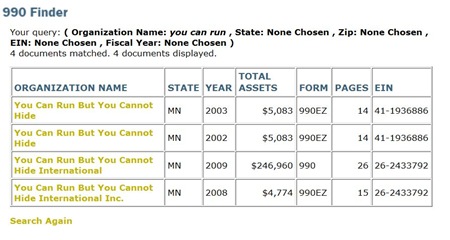
Okay, who really thinks that Bradley Dean Smith (Bradlee Dean) and You Can Run But You Cannot Hide took a spin on Comet Kohoutek between 2002 and 2008?

I don’t think so either. But according to this site, they did give temporal authority the slip between those years:
ycr 990s

(The record that is indicated to be from 2003 is actually the original 2002 non-profit  990 return, as mentioned in the posted linked above, it was corrected, and that is the 2002 record in the database; they both cover activity for the “short” year 2002.)

But we know that YCR was around in the interim, at least to get evicted from its office in Plymouth in 2007!

Let’s try a little inferential exercise to see what was happening to YCR during the “missing years.” Line 9 of the 2002 form 990 shows $35,841 in revenue for the three-month period covered by the “final return.” That includes revenue of $31,819 from gifts and grants. On an annualized basis, that’s just a little short of $144,000.

Moving to 2008, the next period for which YCR files a 990, line 9 of the return shows $385,670 in revenue, and of that $368,903 was gifts or grants. Since the new YCR was incorporated in April of 2008, this revenue is probably for less than for the year, too, perhaps substantially less.

(It is the “grants” that I would love to see broken out by grantor, especially to see how much public money might be included.)

It is safe to say the YCR organization was growing during this time.

But what brought YCR back from the comet, down to earth, in from the cold, in 2008?

It was probably a “come to Jesus meeting.” So to speak.

Karl Bremer has chronicled Smith and YCR’s involvement with the tax frauster Glen Stoll so well that it need not be recounted here. Although you probably will want to read about some of Stoll’s other customers, the people who ran the creationist theme park with dinosaurs and people frolicking together. So it’s easy to see the quality of the intellect that Stoll attracted.

There came a time when Bremer’s posts, and the attention of Andy Birkey, too, became uncomfortable enough that YCR was prompted to get its tax lawyer to write a letter to the publisher of the Minnesota Independent and to complain to the Washington County Sheriff about Bremer. The tax lawyers says, hey, everybody’s current; don’t darken YCR’s doorstep again, intimating that it would be defamation if anybody wrote anything contrary to what the lawyer said.

But, this is the same lawyer who signed as the preparer of YCR’s 990 return for 2009 which showed tax-free ministerial housing allowances to Bradley Dean Smith in the amount of $45,887 and Jacob MacAulay in the amount of $24,869. That’s just for 2009.

By now, you won’t be surprised to know that Karl and Andy wrote about this, too. But I have a little more to add.

Remember the name Judy Sky? Sky Ministries and a church called His Present Glory in Newport, Minnesota are listed as the ordaining or authorizing body in Bradley Dean Smith’s ministerial credential filing in the Big Book of Reverends. Well, it seemed odd that a single church – or person - could make a minister out of Smith, so I decided to inquire. An internet search reveals that His Present Glory is now called 3rd Day Ministries. A telephone call to the number listed for 3rd Day Ministries yields a disconnect message. I found a telephone listing for a Judy Sky, and I’ve left messages at that number – identifying myself as Steve Timmer, not Spot, of course – but those calls have not been returned.

Perhaps more significantly, I have made several requests to YCR – again identifying myself – over the last three weeks requesting information about the ordination or other ministerial credentials of the YCR staff, any seminary or other religious training received by them, and since they preach about it a lot, any constitutional law education received by, especially, Smith and Jacob MacAulay. After the third request, I was told that YCR’s attorney would be in touch, but he never has been.

Without the assistance of the parties, what can we say about YCR’s payment of tax-free ministerial housing allowances to Smith and MacAulay?

If we climb in the way-back machine, and look at the 2002 form 990 for the old YCR, the directors and officers of YCR are listed as follows:

Capture

(Did you note the ministerial housing allowance here, too? Not to mention that Smith and Sky have the same address.)

It certainly looks like Judy Sky has been a mentor to Smith for a long time. And if you read Judy Sky’s testimony on the 3rd Day Ministries website, her religious organizations have been involved, principally, it is fair to say, in substance abuse recovery ministry. Nothing wrong with that, admirable, really. That’s probably how Sky and Smith became acquainted.

But it doesn’t mean that Sky can appoint ministers for tax purposes.

Smith and YCR have ranged far afield, and away from pastoral activities to, inter alia, do a radio show on a conservative political station (with aspirations to go national, apparently), have a punk rock band, and – again according to Dean and MacAulay on the radio – give talks at the behest of conservative political organizations to college political science classes.

Well, it can’t be avoided any longer; we’ll have to look into what the IRS thinks makes a minister for purposes of the housing allowance. That’s what I will try to do, in vivid and arresting prose, in the next post.

Monday, January 31, 2011

Maybe it's just me


But I can't help but notice that over 80% of the sponsors of House File 7, which repeals Minnesota's Local Government Pay Equity Act, are male legislators who have hired female legislative assistants. The purpose of this groundbreaking 1984 law is "to eliminate sex-based wage disparities in public employment in this state" by requiring that those doing comparable work be paid comparably. Used to be that a governmental employer could classify women as one job title at a lower rate of pay and men as another, paying much more -- even if the job duties were identical. This proposal does away with that small step toward pay equity. And as you might expect, it's a GOP proposal by primarily men. Men whose legislative offices are run by women.

But you just have to wonder how those women are going to react when their job titles are changed to "administrative assistants" and their pay cut 20%? After all, administrative assistants - primarily women - aren't as valuable as legislative assistants, important jobs held by men. Going to make for some uncomfortable staff lunches, I'd bet.

Let's hope this idiotic, sexist, backwards legislation goes nowhere.

Pictured: Representative Steve Drazkowski (R-Mazeppa) telling his Legislative Administrative Assistant that besides that cut in pay, she's going to have to start fetching coffee for all the men in the office.

Takin' away our freedoms revisited


I'll bet some of you were thinking that we were joking in that earlier post about the loss of freedom that comes with traffic laws and the need for some Tea Party freedom lovin' deregulation of our streets.

Nope. From Georgia, we hear of State Representative Bobby Franklin Of Marietta, who has proposed the "Right to Travel Act." From the bill:
Free people have a common law and constitutional right to travel on the roads and highways that are provided by their government for that purpose. Licensing of drivers cannot be required of free people, because taking on the restrictions of a license requires the surrender of an inalienable right.
Harking back to the Magna Carta, the bill continues:
In England in 1215, the right to travel was enshrined in Article 42 of Magna Carta:
It shall be lawful to any person, for the future, to go out of our kingdom, and to return, safely and securely, by land or by water, saving his allegiance to us, unless it be in time of war, for some short space, for the common good of the kingdom: excepting prisoners and outlaws, according to the laws of the land, and of the people of the nation at war against us, and Merchants who shall be treated as it is said above.

From what I can tell, Representative Franklin is a bit of a flake. A rundown of the bills he's submitted can be found here. But please don't share the link too widely, we here at the Cucking Stool don't want to go giving the Minnesota GOP any ideas.

Saturday, January 29, 2011

His name is written in the Book

Bradley Dean Smith, that is. But it’s not the Book of Life I’m talking about, it’s the Big Book of Reverends maintained by Wright County. A clerk in the license bureau there told me that Smith signed the book on May 22, 2008. And he’s Bradley Dean Smith in the book, not Bradlee Dean. In order to sign the book, and therefore have the civil authority to marry people, you must be ordained or licensed by a denomination, or have “authority from the minister’s spiritual assembly.”

The latter is the route that Smith apparently followed, listing as his spiritual assembly Sky Ministries – His Present Glory, Newport, Minnesota. “Sky Ministries” has a “heaven above,” “big guy upstairs” kind of a ring to it doesn’t it? Well, in this case, it refers to Judy Sky, the senior minister at the church. Really. So Bradley got his authority from Judy.

Hang on to that name; we’ll come back to it later.

But hasn’t Smith been in the “youth ministry” business for a decade or more? The earliest Form 990 non-profit return to the IRS for Dean’s youth ministry that I can find is for 2002. The return says that the principal purpose of the organization is a “religious youth ministry.” And it is a very curious return, indeed. Here is the top of the first page:

2002 990ez ycr heading

The hand-written language on the top just identifies it as an amended return, no big deal there. That happens all the time. But what is noteworthy is that it indicates that it is a short period “final return” for YCR, as if it was winding up and going out of business. And sure enough, YCR said it was closing up shop:

dissolution recitation by ycr

No forwarding address! But maybe there was! Shortly after this winding up, winding down, and jumping off the corporate cliff, Smith joined the Kingdom of Heaven. He even got a new picture ID for voting purposes:


They’re apparently very worried about voter fraud in the Kingdom of Heaven, too!

Smith and YCR attempted to slip the surly bonds of earth at about the same time. Smith and YCR did both return from taking a spin on Comet Kohoutek in 2008; Smith files as a minister in May, and YCR incorporates (or reincorporates) in April. It is the interim period between blast off and returning to earth that is especially interesting, and which has been the subject of some attention, already.

Also in 2008, in July, Old Paths Church, Inc. was incorporated in Minnesota as a nonprofit, with the same address as YCR in Annandale; Jake MacAulay is listed as the agent for both.

YCR and Old Paths are obviously related entities; in 2008, YCR gave or contributed just under $44,000 to Old Paths or an unincorporated entity with the same name; the figure for 2009 is $37,700. It’s funny, though, that no Form 990 non-profit returns can be found for Old Paths Church, Inc., even though according to YCR itself Old Paths received substantial money from YCR in 2008 and 2009, and the two organizations engaged in “joint ministry activities.” There ARE a number of religious Old Paths organizations, so it is possible that the monies were paid by YCR to another Old Paths, but YCR’s 990s are not transparent on the subject. In any event, there doesn’t seem to be any Old Paths Church entity that has filed a Form 990, from anywhere in the country.

So, did $81K plus get raptured, or what?

In the next installment, I’ll write about “YCR, The Missing Years,” and the taking of tax free ministerial housing allowances by Bradley Dean Smith and Jake MacAulay.

Karl Bremer and Andy Birkey did a lot of early spadework on this story; my thanks, well our thanks, to them.

Thursday, January 27, 2011

Cognitive dissonance at the Star Tribune

Kudos to Star Tribune reporters who set out a few days ago to see what $2 billion in withheld state money has meant to Minnesota schools. The story "Money woes test school quality" is not pretty:
  • In Willmar, students share and check out textbooks instead of bringing them home.
  • In Rochester, some school areas are cleaned only once a week and some staffers bring blankets because of low thermostats.
  • In Two Harbors, the school week was cut to four days, staff took two-year salary freezes and leaders put off replacing buses that rack up 450,000 miles a year in the state's most spread-out district.
  • In Perham, a roof leaks directly onto the school secretary's desk. Says Superintendent Tamara Uselman: "Patch and go and pray for the best."
There are many other indignities. Biology classes with 40 students that don't have enough specimens for experiments. Classrooms with literally not enough chairs for all the students. Clearly budget cutting has taken a toll on our schools. I'm sure if you canvassed all Minnesota public schools you would find similar situations, perhaps many even more dire. $2 billion is a lot to cut out of schools.

One thing you'll never see in a news story like this in the Strib is a connection to the continuing attacks on school teachers as the bane of public education, even though there are usually two or three attacks like that weekly in their own paper. It's not like the two subjects are unrelated. After all, if a teacher stands in front of a standing-room only classroom without necessary supplies in physically uncomfortable conditions that might have some bearing on the achievement of students.

Which brings us to today's editorial endorsing the activities of MinnCan.  The editorial is unremarkable except for its authoritarian style - it doesn't make any arguments about how the things that MinnCan is proposing might improve education. Given the supposed concern for "achievement gaps" in which the editorial is couched, it is notable that not one word is expended either on poverty or lack of funding being important issues. It's clear that the editorialist either doesn't read his/her own paper, or is just not a serious person.

Finally, how unethical is it for Star Tribune editorial writer Denise Johnson to have taken part in the birthing of MinnCan and not revealed that conflict of interest in the editorial, even if she didn't write it? As authoritarian leaders know, anything is okay as long as you get away with it.

* * * * * *

For more on the Star Tribune's dishonest and authoritarian education coverage see my Authoritarian Journalism, and Propagating a dishonest narrative.